Essential Understandings
70 likes | 198 Vues
The 19th-century revolutions in Latin America were significantly shaped by European cultural clashes and the impacts of previous revolutions. Spanish conquests devastated native populations and introduced African slavery, while conquistadors, acting as viceroys, established new rule. Inspired by the American and French Revolutions, Latin American leaders, such as Toussaint L’Ouverture and Simón Bolívar, fought for independence, resulting in the formation of new nations. In 1823, the Monroe Doctrine declared the Americas off-limits for European colonization, emphasizing the U.S. stance against foreign interference.


Essential Understandings
E N D
Presentation Transcript
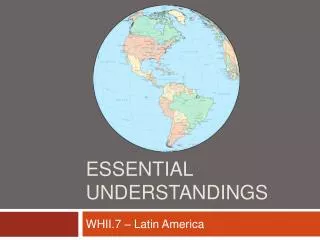
Essential Understandings WHII.7 – Latin America
Essential Understandings • Latin American revolutions of the nineteenth century were influenced by the clash of European cultures in the development of governments and ruling powers.
Essential Understandings • Spanish conquests in Latin America saw the rapid decline of native populations and introduction of slaves from Africa. Conquistadors were given governmental authority by the crown, becoming known as viceroys.
Essential Understandings • The American and French Revolutions took place in the late 1700s. Within twenty years, the ideas and examples of these revolutions influenced the people of Latin America to establish independent nations, most notably in Haiti and Mexico.
Essential Understandings • The contributions of Toussaint L’Ouverture and Simón Bolivar led to the development of independent states in Latin America in the nineteenth century.
Essential Understandings • After the American Revolution, the United States wished to prevent foreign interference in America. The Monroe Doctrine was issued in 1823, alerting European powers that the American continents should not be considered for any future colonization.