Understanding Continuity, Discontinuity, and the Intermediate Value Theorem in Functions
This guide explores the concept of continuity in functions, including the definition of continuous functions, characteristics of discontinuities, and applications of the Intermediate Value Theorem (IVT). A function is continuous if its graph can be drawn without lifting the pencil. We examine where functions are continuous or discontinuous, identifying types such as removable, jump, and infinite discontinuities. Learn to apply the IVT to confirm the existence of solutions and understand compositional rules for continuous functions. Perfect for enhancing your mathematical understanding and homework review.

Understanding Continuity, Discontinuity, and the Intermediate Value Theorem in Functions
E N D
Presentation Transcript
2.3 Continuity Goal: Find continuity at a point. Find continuous functions. Find Composites. Use the intermediate value theorem (IVT)
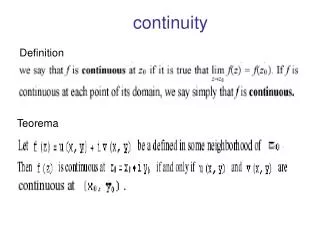
Definition of Continuous Functions Continuous functions are used to describe how a body moves through space and how speed of a chemical reaction changes with time. Any function y=f(x)whose graph is continuous when graph can be sketched without lifting your pencil
Where is the graph continuous and discontinuous a)Where is f(x) continuous b)Is it continuous at x=0, and x=6 c)Where is f(x)discontinuous d)What kind of discontinuity Yes (0,1)(6,-4) At x=2 e) 0 4.84 DNE Jump
Intermediate Value Theorem (IVT) In a continuous graph,
Show there is a solution A number is exactly one less that its cube A solution is determined by f(x)=0
Types of discontinuity Removable Removable Jump Infinite
Composition If the function is continuous then all rules apply for sum, difference, product, quotient, and multiples. Hint let u=substitution
Homework: InterActMath.com 2.3