Download
1 / 11
110 likes | 256 Vues
This overview discusses the determinants of gas diffusion rates in the alveoli, focusing on key factors such as partial pressure differences, surface area, solubility, distance, molecular weight, and pressure gradients. It further examines the diffusion capacities for oxygen and carbon dioxide, highlighting values and gradients essential for understanding gas exchange. Additionally, the relationship between ventilation and perfusion (V/Q) is analyzed, including the significance of adequate flow and ventilation balance, and how physiological shunts and dead space can affect respiratory efficiency.

E N D
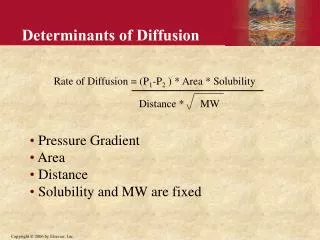
Determinants of Diffusion Rate of Diffusion = (P1-P2 ) * Area * Solubility Distance * MW • Pressure Gradient • Area • Distance • Solubility and MW are fixed
Changes in Alveolar Gas Composition Figure 39-3; Guyton & Hall
Partial Pressure of Oxygen in Alveoli Figure 39-4: Guyton & Hall
Partial Pressure of CO2 in Alveoli Figure 39-5; Guyton & Hall
Alveolar and Blood Gases PO2 = 159 PCO2= 0 PO2 = 149 PCO2 = 0 PO2 = 100 PCO2= 40 PO2 = 100 PO2 = 40 PCO2= 40 PCO2= 45
Diffusion Capacity 120 • Oxygen • Diff capacity 21 ml/min/mmHg * gradient of 11 mmHg • 230 ml/min diffusion of oxygen 100 80 60 in blood 40 2 Po 20 0 0 0.25 0.5 0.75 Pulmonary Capillary Length %
Diffusion Capacity • Carbon Dioxide • Diff capacity 400 ml/min/mm Hg * gradient < 1 mmHg • 200 ml/min diffusion of carbon dioxide 46 45 44 43 blood Pco2 42 41 40 0 0.2 0.4 0.6 0.8 Pulmonary Capillary Length %
Ventilation/Perfusion • Relationship between adequate flow and adequate ventilation • Defined as V/Q • V/Q = (4 L/min)/ (5 L/min) = 0.8
pO2=? pO2=? pO2=? pCO2=? pCO2=? pCO2=? Ventilation/Perfusion V/Q = ¥ V/Q = 0 Shunt Dead space Normal Figure 39-11; Guyton & Hall
Regional Gas Exchange blood flow Va/Q ventilation Top lung Bottom lung Blood flow and ventilation are not evenly matched
Ventilation/Perfusion • Physiologic shunt • Va/Q < normal • low ventilation • Physiologic dead space • Va/Q > normal • wasted ventilation • Abnormalities • Upper lung Va/Q ~ 2.5 • Lower lung Va/Q ~ .5