
Uploaded by
eitan
2 SLIDES
171 VUES
30LIKES
Equivalent Decimals
DESCRIPTION
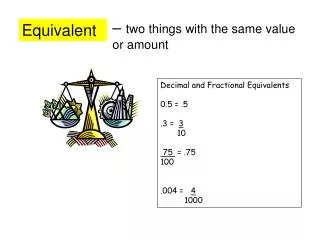
This guide explains the rules for identifying equivalent decimals, highlighting important concepts. Specifically, equivalent decimals exist when numbers share the same place value. It's crucial to note that zeros are significant only when they shift a number into a new place value. For example, 1.3 is mathematically equivalent to 1.3000, while 1.3 does not equal 1.03. Recognizing these distinctions can help strengthen your understanding of decimal representation and its applications in mathematics.
Download
1 / 2
Télécharger la présentation 
Equivalent Decimals
An Image/Link below is provided (as is) to download presentation
Download Policy: Content on the Website is provided to you AS IS for your information and personal use and may not be sold / licensed / shared on other websites without getting consent from its author.
Content is provided to you AS IS for your information and personal use only.
Download presentation by click this link.
While downloading, if for some reason you are not able to download a presentation, the publisher may have deleted the file from their server.
During download, if you can't get a presentation, the file might be deleted by the publisher.
E N D
Presentation Transcript
Rules to Remember: • If the numbers are in the same place value, they are equivalent. • Zeros only matter if they are moving a number into a new place value • Examples: • 1.3 = 1.3000 • 1.3 does not equal 1.03



More Related