Understanding Forces and Newton's Laws in Physics 131
In this class, we dive into the essential concepts of forces, free body diagrams, and Newton's laws of motion. We'll explore how objects move and the forces acting on them. A practical example will clarify the relationship between mass and force: compare a paperback novel and a physics textbook sliding at 5 m/s. As we transition to Chapters 5 and 6, we will discuss why things move the way they do, focusing on the foundational theories introduced by Isaac Newton. Prepare for the next class by reading sections 6.1-6.3 in the textbook.

Understanding Forces and Newton's Laws in Physics 131
E N D
Presentation Transcript
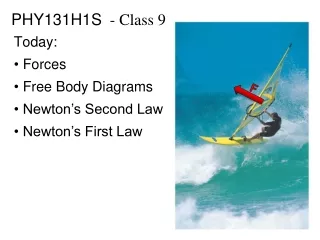
PHY131H1S - Class 9 Today: • Forces • Free Body Diagrams • Newton’s Second Law • Newton’s First Law F
Last day I asked at the end of class: • A paperback novel has a mass of 0.3 kg and slides at a constant velocity of 5 m/s, to the right. A physics textbook has a mass of 3.0 kg, and slides at a constant velocity of 5 m/s, to the right. How does the net force on the textbook compare to the net force on the novel? • ANSWER: • The net force on any object is • In the case of these two books, they are both • , meaning acceleration is • Any friction must be, not mentioned in the question.
Moving on to Chapters 5 and 6.. • Up until now, we have been studying, a description of HOW things move and how to describe this. • In Chapter 5 we begin to study WHY things move the way they do: This is, which includes the important concepts of Force and Energy.
Isaac Newton • 1643-1727 • According to wiki, was a “ , mathematician, astronomer, natural philosopher, alchemist, and theologian and one of the most influential people in human history.” • In PhilosophiæNaturalis Mathematica, published 1687, he described and the , laying the groundwork for classical mechanics.
What is a force? • A force is • A force is . It has both a magnitude and a direction. • A force requires • Something does the pushing or pulling, and something else gets pushed or pulled. • A force is either a • force.is the only long-range force we will deal with in PHY131. • Important contact forces are:
What is Mass? Mass is a scalar quantity that describes an object’s . Loosely speaking, it also describes Mass is an intrinsic property of an object. It tells us something about the object, regardless of where the object is, what it’s doing, or whatever forces may be acting on it.
A fan attached to a cart causes it to accelerate at 2 m/s2. Suppose the same fan is attached to a second cart with smaller mass. The mass of the second cart plus fan is half the mass of the first cart plus fan.
Three forces act on an object. In which direction does the object accelerate?
The “Fine Print” • WARNING: Newton’s Laws only apply in a “ ”. They are not valid if your reference frame is accelerating! • Anreference frame is one that is not accelerating. • The surface of the Earth can be treated as an inertial reference frame because • NOTE:
A car is Quick quiz [1/4]: inside the car, is it…
A car is Quick quiz [2/4]: inside the car, is it…
A car is Quick quiz [3/4]: inside the car, is it…
A car is Quick quiz [4/4]: inside the car, is it…
Before Class 10 on Wednesday • Please read Chapter 6 of Knight, sections 6.1 through 6.3. • Something to think about: A basketball and a tennis ball are in freefall. • Which, if either, has the larger mass? • Which, if either, experiences the larger force of gravity? • Which, if either, experiences the larger acceleration? • Which, if either, has the larger weight?