Download
1 / 1
10 likes | 129 Vues
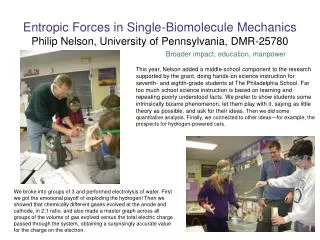
Philip Nelson's research at the University of Pennsylvania, funded by grant DMR-25780, has expanded to include a middle-school component aimed at enhancing science education for seventh and eighth graders at The Philadelphia School. The initiative focuses on hands-on experimentation rather than rote memorization. Students engaged in the electrolysis of water, witnessing the exciting release of hydrogen gas while learning about chemical reactions and energy concepts. This approach not only encourages curiosity and creativity but also connects scientific principles to real-world applications, like hydrogen fuel.

E N D
Entropic Forces in Single-Biomolecule MechanicsPhilip Nelson, University of Pennsylvania, DMR-25780 Broader impact, education, manpower This year, Nelson added a middle-school component to the research supported by the grant, doing hands-on science instruction for seventh- and eighth-grade students at The Philadelphia School. Far too much school science instruction is based on learning and repeating poorly understood facts. We prefer to show students some intrinsically bizarre phenomenon, let them play with it, saying as little theory as possible, and ask for their ideas. Then we did some quantitative analysis. Finally, we connected to other ideas—for example, the prospects for hydrogen-powered cars. We broke into groups of 3 and performed electrolysis of water. First we got the emotional payoff of exploding the hydrogen! Then we showed that chemically different gases evolved at the anode and cathode, in 2:1 ratio, and also made a master graph across all groups of the volume of gas evolved versus the total electric charge passed through the system, obtaining a surprisingly accurate value for the charge on the electron.