Pixel 2000 - notes
This report summarizes key discussions and findings presented at the Pixel 2000 meeting, focusing on advancements in sensor technologies and hybrid electronics. Topics included developments in sensor integration, bump bonding techniques, and hybridization for applications such as ATLAS and CMS. Notable contributions from industry experts shed light on challenges and solutions related to interpixel insulation, moderated p-spray techniques, and the use of oxygenated wafers. Insights into the performance of multichip modules and flex-hybrids further highlight the ongoing evolution in the field.

Pixel 2000 - notes
E N D
Presentation Transcript
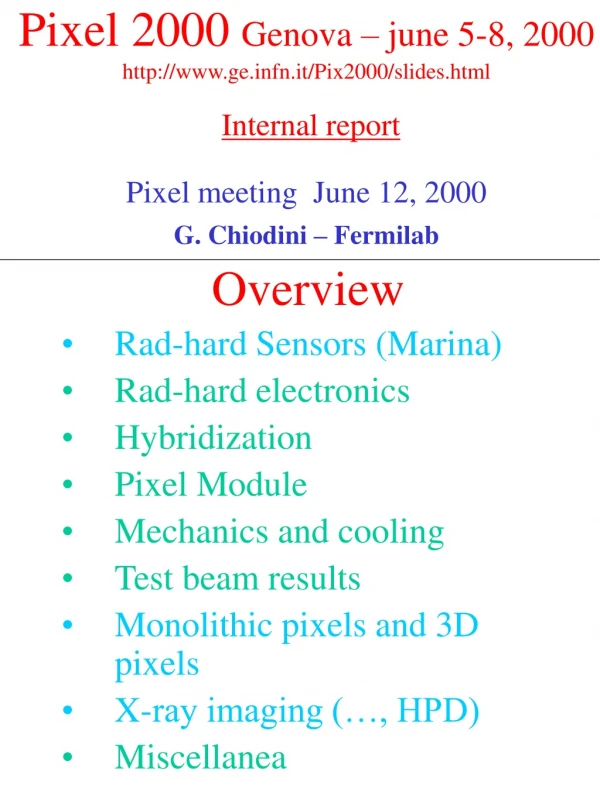
Pixel 2000 - notes • Topics covered • Sensor • Front end electronics • Integration: • Bump bonding (including roundtable featuring AMS,IZM, VTT) • Multichip modules • Hybrids • Web page: http://www.ge.infn.it/Pix2000/slides.html Marina Artuso
Sensor • Interpixel insulation: • ATLAS “moderated p-spray” • CMS “p-stop double open ring” • 250 mm sensors • At Elba meeting CSEM, SINTEF not too enthusiastic, CANBERRA ok 200 mm • CiS produced 1st “moderated p-spray” in 200 mm • IRST (Trento, Italy) has tried to produce “p-spray” and “moderated p-spray” Marina Artuso
Sensor - continued • Discussion with SINTEF • HERA-B sensors: moderated p-spray (3 different B doses for implantation ) • Before irradiation breakdown at about 200 V (guard ring) worsened upon irradiation. Theory: p+ guard ring on the ohmic side create problem (punch through when depletion region reaches guard ring) • P-spray versus p-stop, latter easier, very important for p-spray to achieve quite smooth implantation densities + need to negotiate with MPI (design patented ?). Marina Artuso
ROSE collaboration results • Several talks on oxygenated wafers both at ELBA (2) and at PIXEL2000 (1). Oxygenated wafers very popular. SINTEF in the ROSE collaboration & ok, CSEM had problems with the first iteration of oxygenated wafers for Horisberger, they will try again. Marina Artuso
Bump bonding • Industry representatives: • Annamaria Fiorello – AMS, Italy (In) • Juergen Wolf – IZM, Germany (Solder) • Ikka Suni – VTT, Finland (Solder, including low melting eutectic used for an X ray pixel device with bump size 15 mm on 30 mm pitch • Roland Horisberger reported on PSI experience • Both In and Solder seem adequate technologies Marina Artuso
Hybridization ATLAS specifications for flex hybrid module: - 2 metal layers • * kapton substrate, metal traces on both faces (25 micron thick) • * Copper traces: 7 mm thick, 75 mm minimal distance, • critical issues: • - wire bonds • - stress induced on the bumps (different CTE) and wirebonds Marina Artuso
Hybridization (II) • First results presented on “thin” flex-hybrid: electronics thinned down to 150mm • 3 modules tested at Genova (2 bonded by AMS) • Module 2 is the best with very few dead channels and threshold 3900260 e- and mean noise about 210 e- (however with rather long tail) (see Paulina Netchaeva’s talk). Marina Artuso