Hypertension
Hypertension, or high blood pressure, is a significant health issue characterized by consistently elevated pressure in the arteries, above 140/90 mmHg. It can be essential, with no identifiable cause, or secondary, resulting from conditions like kidney disease or diabetes. While often symptomless, hypertension increases the risk of serious complications such as strokes and heart disease. Prevention and management strategies include lifestyle changes like diet and exercise, along with medications like diuretics and ACE inhibitors. Understanding hypertension's prevalence, especially among African Americans, is crucial for effective treatment.

Hypertension
E N D
Presentation Transcript
Blood Flow www.sdm.scot.nhs.uk/images/pfo.jpg
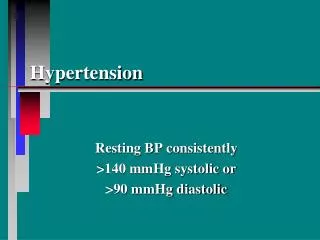
Blood Pressure • Measure of pressure exerted on the wall of the blood vessels • Measure of the pressure exerted when heart contracts • Normal: • Contraction = systole = 105-139mmHg • Relaxation = disystole = 70-90 mmHg • Hypertension greater than 140/90 mmHg • Symptoms --- often none
How controlled • Controlled by mechanism in kidney • Blood flow through kidney • Cells sense the decreased volume, pressure and sodium • Produce a enzyme call “renin” • Renin breaks down protein to form angiotensin I • Angiotension I converted to Angiotensin II by another enzyme called “Angiotension Converting Enzyme” or ACE • Angiotension II increase BP and bring water and sodium into blood
Types of Hypertension • Essential • No identifiable cause • Both systolic reading and disystolic readings are high • Systolic • Fewer cases/ more often in elderly • Systolic reading elevated • Secondary • Kidney disease • Cushings disease • Diabetes • Pre-eclampsia
Prevalence • Less in more physically active group • When controlled for activity, income, smoking, smoking, weight, Black had odds ratio of 1.77 compared to whites (0.73) (Bassett et.al, 2002) • Higher percentage of hypertension in the Southeast- (Hall et.al, 1997) (Glover et.al, 2002) • Black men 35%; Black women 37.7% (40.5%) • White men 36.5%; White women 21.5% (27.4%) • Why? • Obesity– 25% • Diet high in sodium and fat • Lack of education • Access and utilization of health care
Complications • Earlier onset • Stroke- 80% higher stroke mortality • Heart Disease– 50% higher heart disease mortality • Kidney Failure—320% greater End Stage Kidney Disease
Treatment • Diet • Exercise • Drugs • Diuretics– AKA “water pills” • Beta Blockers—block receptors on heart to reduce the contractions • ACE inhibitors • Ca channel blockers • Angiotension II inhibitors
Why more prevalent in African Americans? • Decreased renin • Stress • Genetics • Adaptation • Food • Lack of exercise
References • Hall, et. al. (1997) Hypertension-related morbidity and mortality in the southeatern United States • Glover et al. (2005) Racial/ethnic disparities in prevalence, treatment, and control of hypertension, MMWR weekly, January 14, 54, 7-9 • National Institutes of Health, Joint National Committee on Prevention , Detection, Evaluation and Treatment of High Blood Pressure (1999), http:// www.ncbi.nlm.nih.gov.