Database Design 4: Deriving Tables From Data Models
This detailed overview explores the essential concepts of database design, focusing on the key fields that define relationships between tables. It covers primary keys, which uniquely identify records; foreign keys, which establish links between tables; and composite keys formed from multiple fields. The document also delves into different data model levels—conceptual, logical, and physical—highlighting the importance of database integrity, including entity and referential integrity. Additionally, it provides practical examples for transforming ER models into sound logical database designs.

Database Design 4: Deriving Tables From Data Models
E N D
Presentation Transcript
Review: Relationships in Tables Created by shared key fields
Types of Database Key Fields Primary keys Foreign keys Composite keys
Review: Primary Key • Uniquely identify a record • Must be unique with respect to all other records in the table • You can create surrogate keys to serve as primary keys
Foreign Key Field that is a primary key in another table Used to create a relationship
Composite Key Primary key comprised of 2 or more fields
Review: Levels of data models • Conceptual: describes WHAT data the system contains • Logical: describes HOW the database will be structured, regardless of the DBMS • Physical: describes HOW the system will be implemented using a specific DBMS
Goal of Logical DB Design: Database Integrity • Entity integrity • Every record must have a unique primary key • The primary key value cannot be NULL • Referential integrity • Every foreign key must be the primary key of its parent table • Every foreign key value must exist in its parent table
Steps for Transforming an ER Model into a Sound Logical Database Design • Create a table to represent every entity • Entity PK is table PK • Represent each ER model relationship using foreign keys
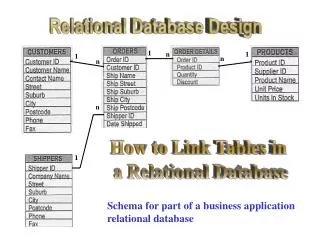
Representing 1:M Relationships • Put the PK of the “1” side into the “M” table ACME_EMPLOYEE(Emp_ID, Emp_Last_Name, Emp_Office, Dept_ID) ACME_DEPARTMENT(Dept_ID, Dept_Name, Dept_Office_Loc)
Why can’t you put the PK of the “M” side into the “1” table? • A department has multiple employees… Approach 1: delimit multiple values using commas? Result: Non-relational tables (cell contains multiple values) • Approach 2: Repeat "1" side records for each "M" record? • Result: Redundant data!
Representing M:M Relationships • Create a linking table • Also called a bridge table • PK is a composite key comprised of PK’s of both entities in the M:M relationship • These fields are part of the PK, and are also FK’s
What do you name the linking table? ACME_EMPLOYEE_PROJECT Typically, a compound word comprised of the two participating entities
What about composite M:M relationships? • If the relationship has an attribute, place the attribute in the linking table
Deriving Tables for 1:1 Relationships • In general, move one entity's non-key attributes into the other entity's table ACME_EMPLOYEE Emp_ID Emp_Last_Name Emp_Office Emp_Spouse_First Emp_Spouse_Last
Deriving Tables for 1:1 Relationships • How do you decide which entity to keep? • The "strong" entity • Typically in a 1:1 relationship, one entity's instance doesn't exist without the other's
Unary Relationships ACME_EMPLOYEE Employee_ID Employee_First_Name Employee_Last_Name Employee_DOB SupervisorID (FK) UWEC_STUDENT_ROOMS_WITH Student1_ID (FK) Student2_ID (FK) Treat just like any other 1:1, 1:M, or M:M relationship, except modify key names to avoid duplicate field names
Ternary Relationships UWEC_STUDENT_ ADVISOR_PROGRAM Student_ID (FK) Advisor_ID (FK) Program_ID (FK) Create a 3-way linking table
Generalization/Specialization Create tables for the supertype and each of the subtypes Put PK of supertype into each subtype table as both a PK and FK
Generalization/Specialization UWEC_Person Person_ID Person_First_Name Person_Last_Name Person_MI Person_DOB Supertype Subtypes UWEC_STUDENT Person_ID (FK) Student_Major_Program Student_Minor_Program UWEC_ INSTRUCTOR Person_ID (FK) Instructor_Title Instructor_Office Instructor_Salary UWEC_Staff Person_ID (FK) Staff_Rank Staff_Hourly_Rate
Generalization/Specialization Data Table Example UWEC_STUDENT UWEC_PERSON UWEC_INSTRUCTOR UWEC_STAFF
Test Yourself: In the CANDY_PURCHASE table, PURCH_ID is an example of a: CANDY_PURCHASE A primary key A foreign key Part of a composite key Both b and c None of the above
Test Yourself: In the CANDY_PURCHASE table, PURCH_ID is an example of: CANDY_PURCHASE A primary key A foreign key Part of a composite key Both b and c None of the above
Test Yourself: In the CANDY_PURCHASE table, PROD_ID is an example of a: CANDY_PURCHASE Primary key Foreign key Part of a composite key Both b and c None of the above
Test Yourself: In the CANDY_PURCHASE table, PROD_ID is an example of a: CANDY_PURCHASE Primary key Foreign key Part of a composite key Both b and c None of the above
Test Yourself: How many database tables would you create for the following ER model? 3 4 5 None of the above
Test Yourself: How many database tables would you create for the following ER model? 3 4 5 None of the above
Your Turn #1 • Derive the tables for the following ER model. Format the table structures using the format TABLE_NAME(Field1, Field2, …). Underline primary key fields, and label foreign keys using the designation (FK).
Your Turn #1 Solution ALS_CUSTOMER(Customer_ID, Customer_Last_Name, Customer_First_Name, Customer_MI, Customer_Address, Customer _City, Customer_State, Customer_Zip, Customer_Phone) ALS_CAR(Car_VIN, Car_Make, Car_Model, Car_Year, Customer_ID (FK)) ALS_WORK_ORDER (WO_ID, WO_Date, Car_VIN (FK)) ALS_SERVICE (Service_ID, Service_Name, Service_Desc, Service_Charge) ALS_WORK_ORDER_SERVICE (Service_ID (FK), WO_ID (FK))
Your Turn #2 • Derive the tables for the following ER model. Format the table structures using the format TABLE_NAME(Field1, Field2, …). Label all primary keys by underlining them, and label foreign keys using the designation (FK).
Your Turn #2 Solution • UWEC_PERSON(Person_ID, Person_First_Name, Person_Last_Name, Person_MI, Person_Email) • UWEC_STUDENT(Person_ID (FK), Stu_Campus_Address, Stu_Campus_City, Stu_Campus_State, Stu_Campus_Zip, Stu_Campus_Phone, Stu_Perm_Address, Stu_Perm_City, Stu_Perm_State, Stu_Perm_Zip, Stu_Perm_Phone) • UWEC_INSTRUCTOR(Person_ID (FK), Instructor_Title, Instructor_Office, Instructor_Office_Phone) • UWEC_COURSE (Course_ID , Course_Dept, Course_Name, Course_Desc) • UWEC_COURSE_SECTION (Section_ID, Section_Term, Section_Day, Section_Time, Section_Location, Person_ID (FK), Course_ID (FK)) • UWEC_STUDENT_COURSE_SECTION(Person_ID (FK), Section_ID (FK), Enrollment_Grade) • UWEC_ADVISOR (Student_Person_ID (FK), Instructor_Person_ID (FK))