Cumulative Magnitude-Frequency Distributions for Earthquake Prediction Models (M≥6.5)
210 likes | 334 Vues
This document details the cumulative magnitude-frequency distributions for earthquake prediction models focusing on M≥6.5 events. It analyzes various total models, including Type-A and Type-B faults, characteristic parts, and background seismicity. The data highlights the observed versus predicted frequencies, providing an overview of parameter changes related to aftershock ratios, coupling coefficients, and fault segmentation. The observations are presented with a 98% confidence interval, showcasing the best-fit models and their implications for understanding seismic activity and fault dynamics.


Cumulative Magnitude-Frequency Distributions for Earthquake Prediction Models (M≥6.5)
E N D
Presentation Transcript
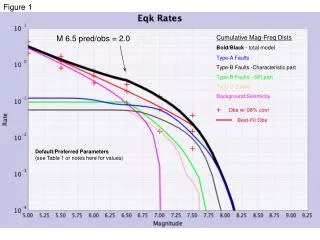
M 6.5 pred/obs = 2.0 Cumulative Mag-Freq Dists Bold/Black - total model Type-A Faults Type-B Faults -Characteristic part Type-B Faults - GR part Type-C Zones Background Seismicity + Obs w/ 98% conf Best-Fit Obs Figure 1 Default/Preferred Parameters (see Table 1 or notes here for values)
M 6.5 pred/obs = 2.7 Cumulative Mag-Freq Dists Bold/Black - total model Type-A Faults Type-B Faults -Characteristic part Type-B Faults - GR part Type-C Zones Background Seismicity + Obs w/ 98% conf Best-Fit Obs Figure 2 Parameter Changes (relative to 1st slide): Aftershock/Foreshock Fraction = 0.0 Coupling Coefficient = 1.0 Fract MoRate to Background = 0.0
M 6.5 pred/obs = 2.0 Cumulative Mag-Freq Dists Bold/Black - total model Type-A Faults Type-B Faults -Characteristic part Type-B Faults - GR part Type-C Zones Background Seismicity + Obs w/ 98% conf Best-Fit Obs Figure 3 Parameter Changes (relative to 1st slide): Segmented A-Fault Solution Types = Minimum Rate (on all faults) NOTE - same result for all = Maximum Rate
M 6.5 pred/obs = 1.8 Cumulative Mag-Freq Dists Bold/Black - total model Type-A Faults Type-B Faults -Characteristic part Type-B Faults - GR part Type-C Zones Background Seismicity + Obs w/ 98% conf Best-Fit Obs Figure 4 Parameter Changes (relative to 1st slide): Segmented A-Fault Solution Types = Minimum Rate (on all faults) Wt On Segment Rates = 0.0
M 6.5 pred/obs = 2.2 Cumulative Mag-Freq Dists Bold/Black - total model Type-A Faults Type-B Faults -Characteristic part Type-B Faults - GR part Type-C Zones Background Seismicity + Obs w/ 98% conf Best-Fit Obs Figure 5 Parameter Changes (relative to 1st slide): Segmented A-Fault Solution Types = Maximum Rate (on all faults) Wt On Segment Rates = 0.0
M 6.5 pred/obs = 1.8 Cumulative Mag-Freq Dists Bold/Black - total model Type-A Faults Type-B Faults -Characteristic part Type-B Faults - GR part Type-C Zones Background Seismicity + Obs w/ 98% conf Best-Fit Obs Figure 6 Parameter Changes (relative to 1st slide): A-Fault Solution Type = Unsegmented Model
M 6.5 pred/obs = 1.9 Cumulative Mag-Freq Dists Bold/Black - total model Type-A Faults Type-B Faults -Characteristic part Type-B Faults - GR part Type-C Zones Background Seismicity + Obs w/ 98% conf Best-Fit Obs Figure 7 Parameter Changes (relative to 1st slide): A-Fault Slip Model = Characteristic (Dsr=Ds)
M 6.5 pred/obs = 1.9 Cumulative Mag-Freq Dists Bold/Black - total model Type-A Faults Type-B Faults -Characteristic part Type-B Faults - GR part Type-C Zones Background Seismicity + Obs w/ 98% conf Best-Fit Obs Figure 8 Parameter Changes (relative to 1st slide): A-Fault Slip Model = Uniform/Boxcar (Dsr=Dr)
M 6.5 pred/obs = 2.0 Cumulative Mag-Freq Dists Bold/Black - total model Type-A Faults Type-B Faults -Characteristic part Type-B Faults - GR part Type-C Zones Background Seismicity + Obs w/ 98% conf Best-Fit Obs Figure 9 Parameter Changes (relative to 1st slide): A-Fault Slip Model = WGCEP-2002 model (Dsr prop to Vs)
M 6.5 pred/obs = 2.2 Cumulative Mag-Freq Dists Bold/Black - total model Type-A Faults Type-B Faults -Characteristic part Type-B Faults - GR part Type-C Zones Background Seismicity + Obs w/ 98% conf Best-Fit Obs Figure 10 Parameter Changes (relative to 1st slide): Mag-Area Relationship = Ellsworth-A (WGCEP, 2002, Eq 4.5a)
M 6.5 pred/obs = 2.2 Cumulative Mag-Freq Dists Bold/Black - total model Type-A Faults Type-B Faults -Characteristic part Type-B Faults - GR part Type-C Zones Background Seismicity + Obs w/ 98% conf Best-Fit Obs Figure 11 Parameter Changes (relative to 1st slide): Mag-Area Relationship = Hanks & Bakun (2002)
M 6.5 pred/obs = 2.4 Cumulative Mag-Freq Dists Bold/Black - total model Type-A Faults Type-B Faults -Characteristic part Type-B Faults - GR part Type-C Zones Background Seismicity + Obs w/ 98% conf Best-Fit Obs Figure 12 Parameter Changes (relative to 1st slide): Mag-Area Relationship = Somerville (2006)
M 6.5 pred/obs = 1.6 Cumulative Mag-Freq Dists Bold/Black - total model Type-A Faults Type-B Faults -Characteristic part Type-B Faults - GR part Type-C Zones Background Seismicity + Obs w/ 98% conf Best-Fit Obs Figure 13 Parameter Changes (relative to 1st slide): % Char vs GR = 100.0
M 6.5 pred/obs = 1.5 Cumulative Mag-Freq Dists Bold/Black - total model Type-A Faults Type-B Faults -Characteristic part Type-B Faults - GR part Type-C Zones Background Seismicity + Obs w/ 98% conf Best-Fit Obs Figure 14 Parameter Changes (relative to 1st slide): B-Faults Min Mag = 5.0
M 6.5 pred/obs = 2.1 Cumulative Mag-Freq Dists Bold/Black - total model Type-A Faults Type-B Faults -Characteristic part Type-B Faults - GR part Type-C Zones Background Seismicity + Obs w/ 98% conf Best-Fit Obs Figure 15 Parameter Changes (relative to 1st slide): Connect More B Faults? = false
M 6.5 pred/obs = 1.7 Cumulative Mag-Freq Dists Bold/Black - total model Type-A Faults Type-B Faults -Characteristic part Type-B Faults - GR part Type-C Zones Background Seismicity + Obs w/ 98% conf Best-Fit Obs Figure 16 Parameter Changes (relative to 1st slide): Include C Zones? = false
M 6.5 pred/obs = 1.7 Cumulative Mag-Freq Dists Bold/Black - total model Type-A Faults Type-B Faults -Characteristic part Type-B Faults - GR part Type-C Zones Background Seismicity + Obs w/ 98% conf Best-Fit Obs Figure 17 Parameter Changes (relative to 1st slide): Mean Mag Correction = +0.1
M 6.5 pred/obs = 1.9 Cumulative Mag-Freq Dists Bold/Black - total model Type-A Faults Type-B Faults -Characteristic part Type-B Faults - GR part Type-C Zones Background Seismicity + Obs w/ 98% conf Best-Fit Obs Figure 18 Parameter Changes (relative to 1st slide): Deformation Model = D2.2
M 6.5 pred/obs = 2.0 Cumulative Mag-Freq Dists Bold/Black - total model Type-A Faults Type-B Faults -Characteristic part Type-B Faults - GR part Type-C Zones Background Seismicity + Obs w/ 98% conf Best-Fit Obs Figure 19 Parameter Changes (relative to 1st slide): Deformation Model = D2.3
M 6.5 pred/obs = 1.0 Cumulative Mag-Freq Dists Bold/Black - total model Type-A Faults Type-B Faults -Characteristic part Type-B Faults - GR part Type-C Zones Background Seismicity + Obs w/ 98% conf Best-Fit Obs Figure 20 Parameter Changes (relative to 1st slide): (BEST CASE FOUND, BUT NOT CREDIBLE?) Coupling Coefficient = 0.67 Segmented A-Fault Solution Types = Minimum Rate (on all faults) A-Fault Slip Model = WGCEP-2002 model (Dsr prop to Vs) Wt On Segment Rates = 0.0 % Char vs GR = 100.0 Include C Zones? = false
M 6.5 pred/obs = 1.5 Cumulative Mag-Freq Dists Bold/Black - total model Type-A Faults Type-B Faults -Characteristic part Type-B Faults - GR part Type-C Zones Background Seismicity + Obs w/ 98% conf Best-Fit Obs Figure 21 Parameter Changes (relative to 1st slide): (MORE CREDIBLE?) Coupling Coefficient = 0.75 % Char vs GR = 85.0 Include C Zones? = false