Area
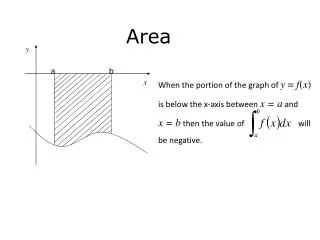
This overview explores the concept of calculating areas using rectangular approximations and summation formulas. It highlights the relationship between the area of rectangles and the area under curves, as represented by the function y = f(x). The Rectangular Approximation Method (RAM) is explained, detailing Left Riemann Sum (LRAM), Middle Riemann Sum (MRAM), and Right Riemann Sum (RRAM). An example illustrating the estimation of the area under the curve for y = -x² + 5 using RRAM with five rectangles is provided for practical understanding.

Area
E N D
Presentation Transcript
Area Section 5.2
Overview: Summation Formulas: Rectangular Area: Area under the curve:
Summation Formulas: (back)
y = f(x) Rectangular Area: Area of a Rectangle = base * height A = height x base A = height · ∆x ∆x A = y · ∆x A = f(x)· ∆x (back)
Area under the curve: Approximating Area using Rectangles and Summations RAM : Rectangular Approximation Method LRAM MRAM RRAM Demo: Class Example (RAM): Unlimited / Infinite amount of Rectangles… (back)
Class Example: Estimate the area under the curve from [0,2] for y = -x^2+5 using RRAM with five rectangles (back)
Infinite Number of Rectangles Add more rectangles (back)