Summarize Strategy
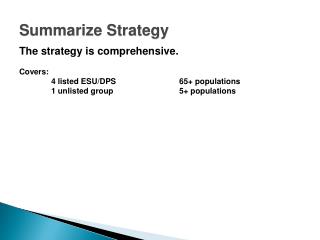
This comprehensive strategy focuses on assessing the management effectiveness of various salmonid populations, including 4 listed and 1 unlisted group, totaling 65+ populations. The strategy incorporates Viable Salmonid Population (VSP) metrics and TRT viability criteria to evaluate population status and trends. It emphasizes adaptive management of hatchery programs concerning recovery criteria and mitigation goals. Additionally, it documents habitat changes due to both natural processes and human actions, aiming to validate fish responses and improve monitoring efforts in relation to the BIOP RPAs and their associated costs.

Summarize Strategy
E N D
Presentation Transcript
Summarize Strategy The strategy is comprehensive. Covers: 4 listed ESU/DPS 65+ populations 1 unlisted group 5+ populations
Summarize Strategy The strategy is comprehensive. The strategy is founded on assessing management action effectiveness. Status and Trend Assess population status and trends using Viable Salmonid Population (VSP) metrics and TRT viability criteria. includes populations with high precision and low precision monitoring Hatchery Assess and adaptively manage hatchery programs to respond to mitigation goals, recovery criteria, and supplementation effectiveness. Habitat Characterize existing physical habitat related to watershed hydrology and aquatic biotic productivity. Document changes in physical habitat structure/function due to natural processes (climate change) and changes resulting from human manipulation of physical habitat (includes both degradation and restoration). Validate fish response to habitat changes..
Summarize the confirmed existing monitoring and its relation to your strategy and the BIOP RPA’s • How it conforms with your strategy • How it informs the BIOP RPA’s • Were there adjustments identified • Were these adjustments cost plus, cost minus or cost neutral, include total amounts * incomplete assessment
Summarize the confirmed existing monitoring and its relation to your strategy and the BIOP RPA’s • How it conforms with your strategy • How it informs the BIOP RPA’s • Were there adjustments identified • Were these adjustments cost plus, cost minus or cost neutral, include total amounts • Number of RPA’s addressed: 46
Summarize the confirmed existing monitoring and its relation to your strategy and the BIOP RPA’s • How it conforms with your strategy • How it informs the BIOP RPA’s • Were there adjustments identified • Were these adjustments cost plus, cost minus or cost neutral, include total amounts YES
Summarize the confirmed existing monitoring and its relation to your strategy and the BIOP RPA’s • How it conforms with your strategy • How it informs the BIOP RPA’s • Were there adjustments identified • Were these adjustments cost plus, cost minus or cost neutral, include total amounts
Summarize any Accord monitoring within your strategy • Needed for the RPA requirements • 6 projects • $3,207,200 • Needed for non-RPA strategy • 4 projects • $839,780
Summarize, by priority, the new monitoring efforts needed to meet the RPA requirements
Summarize, by priority, the new additional monitoring efforts needed to meet the strategy.