Strings, StringBuilder, StringBuffer
Strings, StringBuilder, StringBuffer. String. Strings in java are immutable Once created they cannot be altered and hence any alterations will lead to creation of new string object. Example. String s1 = “Example” String s2 = new String(“Example”) String s3 = “Example”

Strings, StringBuilder, StringBuffer
E N D
Presentation Transcript
String • Strings in java are immutable • Once created they cannot be altered and hence any alterations will lead to creation of new string object
Example • String s1 = “Example” • String s2 = new String(“Example”) • String s3 = “Example” • The difference between the three statements is that, s1 and s3 are pointing to the same memory location i.e. the string pool. s2 is pointing to a memory location on the heap. • Using a new operator creates a memory location on the heap. • Concatinting s1 and s3 leads to creation of a new string in the pool.
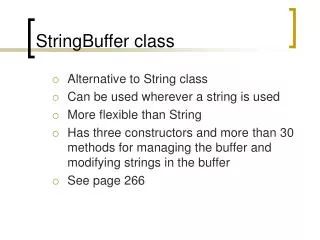
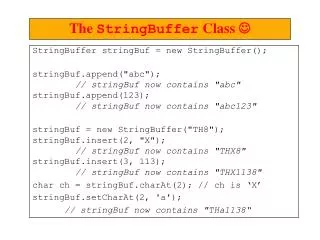
StringBuffer • StringBuffer is a synchronized and allows us to mutate the string. • StringBuffer has many utility methods to manipulate the string. • This is more useful when using in a multithreaded environment. • Always has a locking overhead.
Example public class mybuffers{ public static void main(String args[]){ StringBuffer buffer = new StringBuffer(“Hi”); buffer.append(“Bye”); System.out.println(buffer); } } • This program appends the string Bye to Hi and prints it to the screen.
StringBuilder • StringBuilder is the same as the StringBuffer class • The StringBuilder class is not synchronized and hence in a single threaded environment, the overhead is less than using a StringBuffer.
Further Reading • http://javarevisited.blogspot.com/2011/07/string-vs-stringbuffer-vs-stringbuilder.html