Download
1 / 26
260 likes | 391 Vues
This study examines neutron emission from fission fragments (FF) using a model incorporating level density, absorption cross-section, and excitation energy. Key elements include the calculation of neutron spectra from (p,n) reactions across different nuclei, such as Zr, Ag, Cd, Sn, Ho, and Ta. Notably, the research challenges existing models' assumptions, particularly the Weisskopf assumption, highlighting discrepancies in neutron multiplicity predictions versus experimental data. The findings underscore the complexity of neutron emission mechanisms and call for refined models for accurate PFNS calculations.

E N D
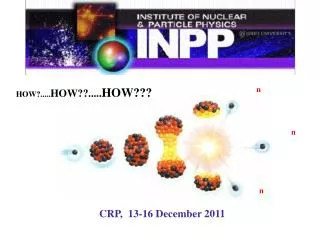
n n n CRP, 13-16 December 2011
PFNS evaluation with “scale method” NS&E 169, 290-295 (2011)
Model for Prompt Fission Neutron EmissionN. Kornilov et al, ISINN-12, Dubna, 2004N. Kornilov et al, NPA 786, 2007, 55-72 I added Neutron spectra calculation now Input data • Y(A,TKE) • Level density. (Level density model should be applied to extrapolate into FF mass range) • Absorption cross section (optical model) • Energy release and binding energies (G.Audi and A.H.Wapstra) Assumptions • Neutron emission from excited, moving FF (full acceleration) • Total excitation energy U= Uh +Ul = Er-TKE • Uh and Ul from equilibrium This model = LANL model (Weisskopf assumption)
2D distribution TKE * A FF masses TKE-100, MeV
Neutron spectra from (p,n) reactions • 94Zr(p,n); Ep=8, 11 MeV (Zhuravlev et all, IPPE) • 109Ag(p,n); Ep=7, 8, 9,10 MeV (Lovchikova et all, IPPE) • 113Cd(p,n); Ep=7, 8, 9,10 MeV (Lovchikova et all, IPPE) • 124Sn(p,n); Ep=10.2, 11.2 MeV (Zhuravlev et all, IPPE) • 165Ho(p,n); Ep=11.2MeV (Zhuravlev et all, IPPE) • 181Ta(p,n); Ep=6, 7, 8, 9, 10 MeV (Lovchikova et all, IPPE)
BUT Ignatjuk’s Level Density failed for PFNS235U, thermal <E>=1.85 MeV
PFNS description contradict to experimental data from (p,n) reactions
Self-checking of experimental data • Experimental data have been analysed with assumption: Neutron emission from excited, moving FF (full acceleration) We have: ν(A), <ε>(A), Y(A), TKE=>Ew(A) for LF and HF. So we can return back and calculate ν and <E> - average neutron energy in LS.
235U “3 sources model” <Escn> = 2.38 MeV
MC simulation and experiment • There is NOT CMS=>LS transformation • E1/2 instead of E
Conclusion • Theoretical model can not describe simultaneously numerous experimental data. So, this model is wrong(>90%) in main assumption; • Many neutrons are emitted along FF direction BUT not due to “evaporation from excited, moving fragments”; • ν(TKE) is the crucial point. May be if we will explain this huge slope (~19 MeV/n instead of ~9 MeV/n) we will understand the mechanism of neutrons emission in fission; • After this we will create (may be) new model for PFNS calculation; • Until this we have in hand only “semi-empirical models” for practical application; • LS experimental spectra for different angles should be compared with model calculations directly.
Intrinsic feature CMS => LS transformation E1/2 ε1/2 μ Ew1/2 μ – LS cosine ε>Ew(1-μ2)