Download
1 / 29
300 likes | 425 Vues
This presentation explores the application of improved cosmological evolution and dark energy through the lens of renormalization group (RG) theory and effective field theory. It discusses the fundamental concepts of RG equations, Wilsonian RG, and their relevance to cosmology and fundamental physics. The focus is on how effective actions can provide insights into cosmic dynamics, particularly in dark energy-dominated universes. The discussion illustrates the relationship between energy scales and effective theories, emphasizing stability and fixed points in the context of cosmological models.

E N D
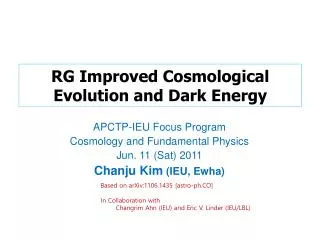
RG Improved Cosmological Evolution and Dark Energy APCTP-IEU Focus Program Cosmology and Fundamental Physics Jun. 11 (Sat) 2011 Chanju Kim (IEU, Ewha) Based on arXiv:1106.1435 [astro-ph.CO] In Collaboration with Changrim Ahn (IEU) and Eric V. Linder (IEU/LBL)
Outline • Renormalization group(RG) equation • Basic idea of effective field theory • Wilsonian RG • Exact RG equation • RG improved cosmological evolution
Idea of Effective Field Theories • World ~ various physical phenomena at all scales • In principle, Theory of Everything could explain all these phenomena • In practice, Impossible and unnecessary to use TOE • Divide the parameter space of the world into different regions. • Common relevant parameter: Energy scale • Change energy scale under consideration Different effective action Example: Weinberg-Salam vs Fermi theory
Wilsonian RG • The idea of effective theories can be naturally formulated in Wilsonian RG • Consider a quantum field theory with a characteristic energy scale : low frequency modes : high frequency modes
Physics at : • Integrate out high frequency modes with where • : “Wilsonian Effective Action” • Serves as the action describing physics at low energy • How does change as we vary “Renormalization Group Equation”
Alternative View of • Bare action (with initial UV cutoff : propagator : interaction part of the bare action • Generating Functional Integrate out higher freq. modes
Divide the propagator and fields into two parts where Has UV cutoff IR cutoff
Dual role of • : generating functional of connected Green functions with UV cutoff & IR cutoff • : : effective action • What if both are nonzero? • gives a relation between the generating functional and effective action
with , • This integral is gaussian. The result is which is a function of the combination • Rewrite the first term as
We can finally express as where • Then • If is precisely the effective action
For general , we obtain a precise relation between effective action and the generating function in the quantum field theory (with Keller, Kopper & Salmhofer (1991) • In: IR cutoff • In , : UV cutoff • Effective action with UV cutoff • Generating functional with amputated connected Green functions with IR cutoff
RG Equation • Take derivative w.r.t. For , Wegner, Houghton(1973), Polchinski(1984)
1PI Generating Functional • Legendre transform • Define the interaction part as
Interaction part satisfies • We finally obtain “Exact RG” Wetterich (1993) Bonini, D’Attanasio & Marchesini Morris • Note 1: The choice of the cutoff function is arbitrary • Sharp cutoff: • Smooth cutoff: e.g. • Choosing the cutoff function is a kind of “renormalization scheme” (Physical quantities should independent of it.)
Note 2: The separation of the action into the free and the interaction part is arbitrary • One may start from, e.g., : full bare action : pure cutoff term added to the action Then all the previous equations are valid with and replaced by and :
Approximation • Practically, impossible to solve RG equation exactly • An obvious approximation: derivative expansion • Nonperturbative approximation • RG equation reduces to differential equations of coefficient functions and • Scheme independence lost • Successfully applied to many problems including gauge theories • Cutoff breaks gauge symmetry • Modified Ward identity
Application to Cosmology • Effective action of Einstein gravity in “Einstein-Hilbert truncation” : -dependent • Matter: scalar field(dark energy part) + barotropic fluids : -dependent absorb into
Equations of Motion • Effective action contains quantum effects • The form of the eq. of motion unchanged in our approximation except and • In FRW universe, : total energy density and pressure • In addition, we have a Klein-Gordon equation
IR cutoff and Time • Universe with age • Quantum fluctuations with momenta smaller than do not play any role may not be integrated out • Then the IR cutoff is a function of time • may also depend on Hubble parameter , i.e., are time-dependent Extra time dependence in Eq. of motions • Need to check that the truncation of RG is consistent
Bianchi Identity • Friedmann eqs come from Einstein equation • Einstein tensor automatically satisfies Bianchi identity covariant derivative of rhs should vanish • If is constant, this is the usual continuity eq. • equation modified • In FRW cosmology i.e.,
For the dark energy component, where are RG parameters , • On the other hand, Consistency condition:
RG improved Eqs • Introduce • Eqs of motion can be rewritten as
Consistency condition Then • and will be determined if the potential is given • Here, we will consider possible fixed points at which
Fixed Points 1. Accelerating, dark energy dominated • If asymptotically, approaches de Sitter state • Stable fixed point for
2. Scaling • dark energy and barotropic component have densities in a constant ratio • not accelerating unless one already had an accelerating barotropic component
3. Flowing, dark energy dominated • depends on specific values of RG parameters
Relation of to Hubble Scale • Partial differentiation of Friedmanneqwrt • Apply the consistency condition : t-dependent • In the truncated RG, we cannot simply assume without explicit time dependence
Newton constant • Newton constant and • CMB & primordial nucleosynthesis abundances shows const up to a precision 10% over time: • This gives a condition on • can be achieved for small or slow flow
Conclusion • We have explored the quantum modifications to cosmological evolution at late times • In the approximation scheme used, we found a consistency condition which restrict the relation between the RG parameters and the cosmological quantities • Three classes of fixed points identified • Future works • Solve RG explicitly for various specific potentials • beyond Einstein-Hilbert truncation