Understanding the Evolution of Presidential Power in U.S. History
This analysis explores the expansion of presidential power in the United States from the founding fathers to modern times. It reviews surveys of historians ranking presidents, with figures like George Washington and Franklin D. Roosevelt at the top. The role of media, the focus on the presidency as a unifying force, and the impact of global conflicts and domestic crises are examined. The sentiment towards presidential power has shifted over decades, illustrating changing public perceptions influenced by historical events like World War II and the Great Depression.

Understanding the Evolution of Presidential Power in U.S. History
E N D
Presentation Transcript
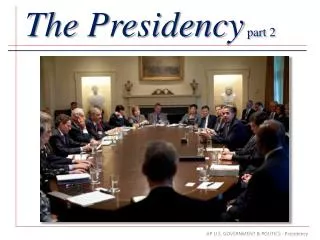
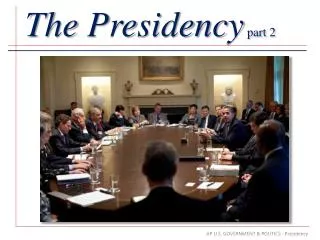
The Presidency part 2 AP U.S. GOVERNMENT & POLITICS - Presidency
Rank The President the Presidents AP U.S. GOVERNMENT & POLITICS - Presidency
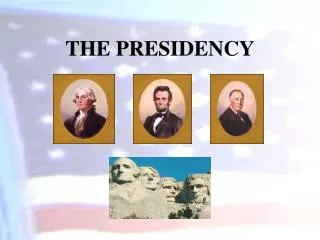
Survey of Historians: 11. Lyndon Johnson 10. Ronald Regan 9. Woodrow Wilson 8. Dwight Eisenhower 7. Thomas Jefferson The President AP U.S. GOVERNMENT & POLITICS - Presidency
Survey of Historians: • John F. Kennedy • Harry Truman • Franklin D. Roosevelt • 3. Theodore Roosevelt • 2. George Washington The President AP U.S. GOVERNMENT & POLITICS - Presidency
The Expansion of PresidentialPower Since the days of Presidents have developed new roles and expanded the power of the office. HOW? The President AP U.S. GOVERNMENT & POLITICS - Presidency
The Expansion of Presidential Power – How? • The Constitution is not very specific on powers or • limits . . . basically says the job of the Prez is . . . • “to take care that the laws be faithfully executed” • Exercise of power sets a precedent for future exercise • of power . . . builds over time The President AP U.S. GOVERNMENT & POLITICS - Presidency
The Expansion of Presidential Power – How? • Focus of media attention, “spokesman for the nation” • The People tend to rally behind the President as he • “stands for the country” • Commands the military and intelligence gathering • agencies (CIA, FBI) The President AP U.S. GOVERNMENT & POLITICS - Presidency
The Expansion of Presidential Power – How? • Use of the Attorney General & Justice Department to • argue for the legality of presidential actions • Growth of the bureaucracy, part of the Executive branch • Access to and control of information • Need for government to act quickly, the President can • act quicker than Congress or the Courts The President Military conflict Natural Disasters AP U.S. GOVERNMENT & POLITICS - Presidency
Perspectives on Presidential Power During the 1950’s and 1960’s people favored a powerful president. Logical outcome of Winning World War II And emerging out of the Great Depression “We’re Number One!” The President AP U.S. GOVERNMENT & POLITICS - Presidency
Perspectives on Presidential Power During the 1950’s and 1960’s people favored a powerful president. Who was president during this time? The President AP U.S. GOVERNMENT & POLITICS - Presidency
Perspectives on Presidential Power By the 1970’s, presidential power was checked and distrusted by the public. Who was president during this time? The President AP U.S. GOVERNMENT & POLITICS - Presidency
Other Perspectives from the 60’s • Disillusion over . . . The President AP U.S. GOVERNMENT & POLITICS - Presidency
Other Perspectives from the 60’s • Loss of idealism after . . . The President AP U.S. GOVERNMENT & POLITICS - Presidency
And then . . . Came a leader on a white horse Promising that we could become a “shining city on a hill” and defeat the evil Soviet Empire and we would once again be NUMBER ONE Who? The President AP U.S. GOVERNMENT & POLITICS - Presidency