
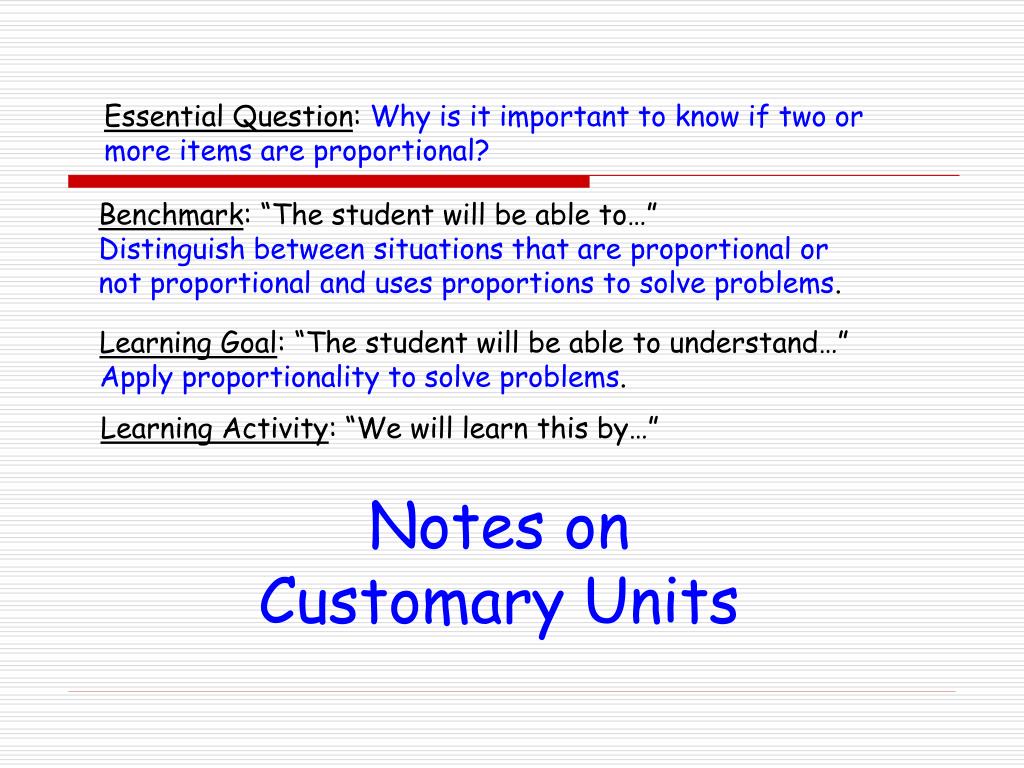
Notes on Customary Units

Knowing if items are proportional is crucial in various real-world applications, such as cooking, construction, and finance. It enables students to identify relationships between quantities, solve complex problems, and make informed decisions. In this lesson, we will differentiate between proportional and non-proportional situations and apply that understanding using customary units like feet, pounds, and gallons. Students will learn through practical examples and exercises, preparing them for future assessments and everyday problem-solving.
Télécharger la présentation 
Politique de téléchargement : le contenu du site vous est fourni TEL QUEL pour votre information et votre usage personnel ; il ne peut être vendu, concédé sous licence ni partagé sur d’autres sites sans l’accord de son auteur.Le contenu vous est fourni TEL QUEL, pour votre information et votre usage personnel uniquement. Téléchargez la présentation en cliquant sur ce lien. Lors du téléchargement, si vous ne parvenez pas à télécharger une présentation, l’éditeur a peut-être supprimé le fichier de son serveur.Pendant le téléchargement, si vous ne parvenez pas à obtenir une présentation, le fichier a peut-être été supprimé par l’éditeur.
F I N