Ancient Civilizations
Explore the fascinating world of ancient civilizations, including the Sumerians in Mesopotamia, the Harrapan civilization of Indus Valley, and the remarkable Egyptians along the Nile. From the creation of cuneiform as the first written language to the architectural marvels of ziggurats and pyramids, these cultures laid the foundation for modern society. Learn about their agricultural innovations, polytheistic religions, and remarkable achievements in city planning and engineering, which demonstrate their influence on subsequent civilizations.

Ancient Civilizations
E N D
Presentation Transcript
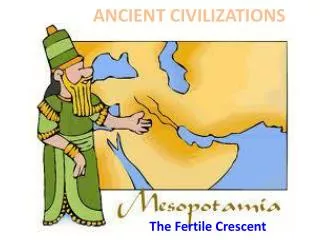
Sumerians • Located in the Mesopotamia, or the Fertile Crescent,in what is now Iran/Iraq as early as 5,300 B.C. • Fertile Crescent- River Valley of the Tigris and Euphrates • Eridu is believed to be the first city • Made of city states
Agriculture • First to create a large irrigation system (bring water to fields) • Accomplished through use of shaduf, canals, channels, dykes, weirs, and reservoirs • Grew barley, chickpeas, lentils, wheat, dates, onions, garlic, lettuce, leeks, and mustard
Written Language • Created by the need to keep record of farming • Cuneiform- Wedge shapes used to show syllables • First written language to do so • There was writing before, but mostly pictures to indicate things, not syllables
Religion • Due to Cuneiform we are able to know exactly what they believed • Created massive temples called Ziggurats • Polytheistic (many gods) religion, which included An, the god of “heaven” and Enki, the goddess of the Earth
Indus Valley • Also known as the Harrapan Civilization • Dates back to 3300 B.C. • Located along the Indus River in what is now Pakistan and India • Major cities are Harappa and Mojenjo-daro • Written language is still indecipherable
Religion • Many seals show signs of swastikas • Uses many animal symbols • Especially the bull- Jainism • Precursor to many Eastern Religions • No large temples
Ingenious Indus • City planning and sewage/drainage • Indoor plumbing • First evidence of dentistry • Bronze!!
Decline • There is a theory that they were attacked and slowly destroyed by of group called the Aryans • Most people believe that their decline was due to droughts and tectonic activity
Egotistical Egyptians • One of the most studied ancient civilizations • Also very stereotyped • http://www.youtube.com/watch?v=wgTPH5y1-ZI • Found along the Nile River
Divine Dynasties • Egypt was split in two kingdoms at first The Lower Kingdom in the North and theUpper Kingdom in the South • Believed to have been united by the pharaohNarmer
The 3 Periods • The Old Kingdom 2686 – 2181B.C. • This was when the Great Pyramid of Giza and the Sphinx were built • The Middle Kingdom 2134 – 1690 B.C. • Restoration of a unified state • Expansion • New Kingdom 1549 – 1069 B.C. • Hatshepsut- Great ruler that grew trade during peace • Ramesses II- Lead to greatest expansion of the empire
Language/Religion • Written language- Hieroglyphics • A hieroglyph can represent a word or a sound and can serve different purposes in different situations • Believed that Pharaoh was a god king • Believed in many gods who each had their own cult
Is it Halloween? • Everyone is usually knowledgeable on their burial rites • Mummies! • Dissected the body and put organs into jars • Buried with many riches and things they would need for the next life
Why Are They Important? • Created massive monuments without cranes • Huge advances in math, astronomy, and architecture, and medicine • Created first “paper” made out of strands of papyrus • One of the most well preserved
Decline • Their huge expansion in the New Kingdom left the empire vulnerable • This mixed their reputation as wealth made them targets for several nations across Africa and the Mediterranean
Mellow Yellow River • Earliest evidence of writing dates back to 13th century B.C. • They are not talked about a lot because the things they accomplished happened earlier elsewhere in the world • Why are they important? • This was the foundation in which China and most of Southeast Asia came from