Download

1 / 8
90 likes | 240 Vues
Ancient Egypt and Kush thrived along the Nile River, relying on its fertile land for agriculture. Their rich polytheistic religion promised a happy afterlife, highlighted by Akhenaton's attempt to shift worship to Aton. Egyptians excelled in various fields, including medicine, astronomy, and hieroglyphics, while Pharaoh Khufu's monumental constructions symbolized power. A centralized government fostered stability, exemplified by Ramses II, while trade flourished under Queen Hatshepsut. Society was stratified, from pharaohs and priests to laborers, reflecting a complex social structure that defined ancient civilizations.

E N D
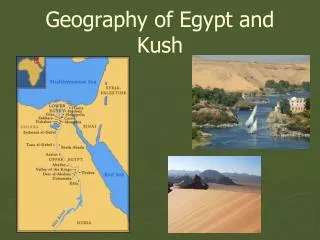
Geography • Located in Africa • The Nile River helped Egypt develop a civilization • Egypt’s economy depended on farming
Religion • Believed in many gods • Polytheistic – belief in more than one god • Believed in a happy after life (life after death) • Akhenaton tried to replace Egyptian old gods with one god called Aton.
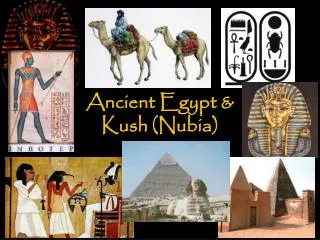
Achievements • Egyptians made advances in calendars, geometry, medicine, astronomy, • Egyptians developed a writing system called • Hieroglyphics which are pictures that stand for different words or sounds • Pharaoh Khufu built a huge monument to proclaim his glory
Politics • Egypt united under a central government that ruled for centuries • Egypt entered a period of change as centralized rule weakened • Ramses II ruled Egypt for decades and created a stable empire
Economy • Fertile land provided everything Egyptians needed • The Nile and other resources influenced Egypt’s economy • Strong economy because of mining, fishing, hunting, and trade • Egyptians developed a complex society with many different jobs and social roles • Queen Hatshepsut ruled as pharaoh and expanded trade during the New Kingdom
Social Structure • Pharaoh – the ruler was above all other people because he or she was considered a god • Priests – The priests cared for the temples and held ceremonies to keep the gods happy • Scribes – trained in the art of writing and record keeping • Craftspeople and merchants- built architecture, monuments • Farmers- took care of the fields and crops • Laborers and slaves – bottom of society. They became slaves if they owed a debt, committed a crime, or were captured in war