Download
1 / 2
20 likes | 160 Vues
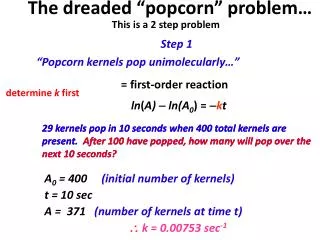
This guide tackles the "popcorn problem" using first-order kinetics to determine the rate of popcorn kernel popping. By analyzing the number of kernels that pop over specified time intervals, we can derive the rate constant (k) and apply it to different scenarios. Starting with 400 kernels, we find that 29 pop in 10 seconds, leading to a calculation of k = 0.00753 sec⁻¹. After 100 have popped, we explore the next interval with 300 kernels remaining, ultimately calculating that approximately 22.75 kernels will pop in that period.

E N D
Step 1 • “Popcorn kernels pop unimolecularly…” • The dreaded “popcorn” problem… • This is a 2 step problem = first-order reaction ln(A) -ln(A0) = -kt determine k first • 29 kernels pop in 10 seconds when 400 total kernels are present. After 100 have popped, how many will pop over the next 10 seconds? • 29 kernels pop in 10 seconds when 400 total kernels are present.After 100 have popped, how many will pop over the next 10 seconds? • A0 = 400(initial number of kernels) • t = 10 sec • A = 371 (number of kernels at time t) • k = 0.00753 sec-1
Step 2 • Start over with a new initial condition • 1st ORDER: ln(A) -ln(A0) = -kt • and k = 0.00753 sec-1 • After 100 have popped, how many will pop over the next 10 seconds? • A0 = 300(initial number of kernels) • t = 10 sec • k = 0.00753 sec-1 • Answer: 300-278.25 = 22.75