After School Programming Professional Development & Instructional Quality
This study evaluates the professional development of staff in the City of Wilmington's after-school programs, highlighting the relationship between staff training and instructional quality. As the demand for high-quality after-school programming increases, it is crucial to explore effective methods for assessing strengths and weaknesses, supporting youth academic success, and fostering positive developmental outcomes. By identifying key practices in professional development, this research aims to improve educational outcomes for children participating in after-school settings.

After School Programming Professional Development & Instructional Quality
E N D
Presentation Transcript
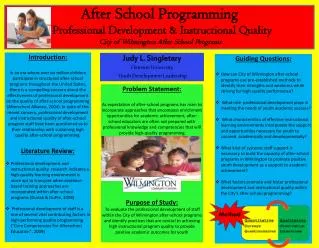
Introduction: • In an era where over six million children participate in structured after-school programs throughout the United States, there is a compelling concern about the effectiveness of professional development on the quality of after-school programming (Afterschool Alliance, 2004). In spite of this recent concern, professional development and instructional quality of after-school program staff have been questioned as to their relationship with sustaining high quality after-school programming. • Literature Review: • Professional development and instructional quality research indicates a high-quality learning environment is more apt to transpire when evidence-based training approaches are incorporated within after-school programs (Durlak & DuPre, 2008) • Professional development of staff is a one of several vital contributing factors in high-performing quality programming ("Core Competencies For Afterschool Education", 2009) Judy L. Singletary Clemson University Youth Development Leadership • Guiding Questions: • How can City of Wilmington after-school programs use pre-established methods to identify their strengths and weakness while striving for high-quality performance? • What role professional development plays in meeting the needs of youth academic success? • What characteristics of effective instructional learning environments incorporate the support and opportunities necessary for youth to succeed academically and developmentally? • What kind of systemic staff support is necessary to build the capacity of after-school programs in Wilmington to promote positive youth development as a support to academic achievement? • What factors promote and foster professional development and instructional quality within the City’s after-school programming? Problem Statement: As expectation of after-school programs has risen to incorporate approaches that encompass enrichment opportunities for academic achievement, after-school educators are often not prepared with professional knowledge and competencies that will provide high-quality programming Purpose of Study: To evaluate the professional development of staff within the City of Wilmington after-school programs and identify practices that are central to achieving high instructional program quality to provide positive academic outcomes for youth After School Programming Professional Development & Instructional Quality City of Wilmington After School Programs