Enhancing Problem Solving through Collaborative Project-Based Learning in ICT Classrooms
This initiative aims to engage Sec 1 Express pupils in structured problem-solving using the design process. Students will effectively utilize PBwiki and MindMeister for collaboration, fostering communication and critical thinking skills. The lessons, conducted in a full-computer lab, are centered around project-based learning to create meaningful solutions. Through the design stages, pupils will analyze, organize findings, and construct ideas collaboratively, ultimately enhancing their intrinsic motivation and sense of belonging in their learning environment.

Enhancing Problem Solving through Collaborative Project-Based Learning in ICT Classrooms
E N D
Presentation Transcript
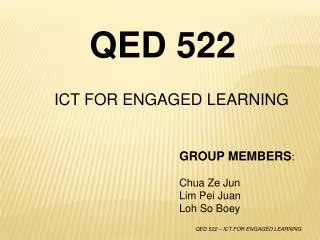
QED 522 ICT FOR ENGAGED LEARNING GROUP MEMBERS: Chua Ze Jun Lim Pei Juan Loh So Boey
LEARNING OBJECTIVES Sec1 Express pupils will effectively use the design process and tackle problem solving activities in a structured matter with the use of mindmap and pbwiki for collaboration. + =
LEARNING ENVIRONMENT • The lessons will take • place in a Full-Computer • Lab. • Students will be learning • in groups
Syllabus Framework • MOE – D&T Syllabus framework comprises 3 domains, • Design Appreciation • Designing • Making 2007 D & T (Lower Secondary - Special / Express / Normal (Academic)) Syllabus (http://www.moe.gov.sg/education/syllabuses/sciences/)
Syllabus Framework Flow of the design stages (http://www.moe.gov.sg/education/syllabuses/sciences/)
LESSON OBJECTIVES Lesson 1 Students are able to : • effectively carry out their discussion with the use of pbwiki.- • learn and organise their findings and make connections to the information gathered. • analyze and build on knowledge through process of collaboration.
LESSON OBJECTIVES Lesson 2 Students are able to : • To analyze and construct own ideas so that they can design meaningful solution to solve the problem while doing their project. • Effectively collaborate, brainstorm, visualize and plan ideas collaboratively online.
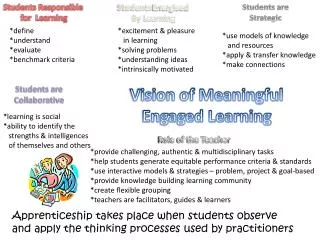
Description of roles (Teacher and ICT) Thinking along engaged learning framework…..
SAMPLE PRODUCT http://dnt-sec1a.pbwiki.com/ http://designteam-one.pbwiki.com/
TECHNOLOGY USED: • PBWIKI • MINDMEISTER
How PBWIKI support engaged learning (1) Student are intrinsically motivated and have a sense of belonging as they are involved in maintenance their resources in pbwiki. (2) They learn best with collaboration and working as groups because it allows knowledge co-construction through peer learning interaction.
How Mindmeistersupport engaged learning? (1) Allow collaboration through brainstorming and think innovatively (2) Allow them to see connections and inter-relationship with the use of visual map. (3) Build on to existing knowledge and information and think further to solve a problem.
Pedagogical approaches Focus: Project-Based Learning
Rationale of the pedagogical approach • Project-based learning: • Nurturing students’ development of critical thinking by • encouraging them to be actively involved in their • own learning. • Allowing students to construct or co-construct their • ideas and those of their peers so as to create • meaningful solutions to solve an authentic problem. • Engaging students to have an overview of their • project through construction of mind-maps and • exposing them to the design process.
Rationale of the pedagogy approach • Project-based learning: • Teacher will act as a facilitator and closely monitor • students’ progress as they work collaboratively; • as well as to give feedback for the students to • evaluate. • Provide opportunities for the students to think , work, • present and evaluate their work.
Instructional Strategies Learning Environment
Instructional Strategies • Cooperative Learning Strategies: • Numbered Heads • Send-A-Problem • Virtual Listening Post (give eg. Like give design brief to the problem tt they identify) • 5W1H to different design factors • Focus on essentials. • Make linkages obvious and explicit. • Prime background knowledge. • Provide temporary support for learning. • Use conspicuous steps and strategies. • Review for fluency and generalization.
Instructional Strategies • Thinking Skills • Identifying attributes and components • Identify the problem-solution pattern of an event through brainstorming.
References (1) Anchored Instruction: - To actively engage students in learning http://viking.coe.uh.edu/~ichen/ebook/et-it/ai.htm (2) Project-Based Learning http://www3.moe.edu.sg/edumall/tl/it_integration/engaging_it_practices/lib2project.htm (3) Cooperative Learning Strategies (http://www3.moe.edu.sg/edumall/tl/it_integration/engaging_it_practices/libstrategies-cooperative.htm)