Colligative Properties in Solution
Explore colligative properties, including vapour pressure depression, boiling point elevation, freezing point depression, and osmotic pressure. Learn how these properties impact solutions and their applications in various fields.

Colligative Properties in Solution
E N D
Presentation Transcript
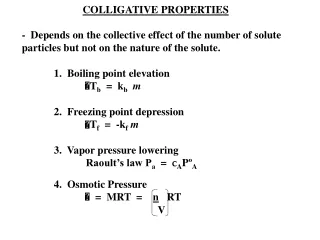
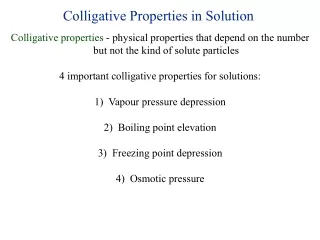
Colligative Properties in Solution • Colligative properties - physical properties that depend on the number but not the kind of solute particles • 4 important colligative properties for solutions: • 1) Vapour pressure depression • 2) Boiling point elevation • 3) Freezing point depression • 4) Osmotic pressure
Vapour Pressure Depression • The addition of a non-volatile solute (i.e. sugar) to a volatile solvent lowers the vapour pressure of that system. • Raoult’s Law PSolvent = XSolventP oSolvent • where, PSolvent = vapour pressure of the solvent in the solution • XSolvent = mole fraction of solvent in the solution • P oSolvent = vapour pressure of pure solvent PSolvent P oSolvent
Vapour Pressure Depression • The total vapour pressure may decrease or increase if two volatile liquids (A & B) are mixed together. PTotal = PA + PB • Raoult’s Law is still obeyed because the partial pressure of A decreases with the addition of B and the partial pressure of B decreases with the addition of A. PA = XAPAo PB = XBPBo P = PA + PB PAo PBo PA PB
Deviations from ideal behavior • Positive deviation is due to the association • between solute-solute and solvent-solvent • (differences in polarity between the solute • and the solvent) • Negative deviation is due to the • association between solute-solvent • (strong intermolecular interactions • between solute and solvent molecules)
Boiling Point Elevation • The boiling point of a solvent increases with the addition of a non-volatile solute. • Boiling point - The point at which the vapour pressure of a liquid/solution is equal to the external pressure. • Raoult’s law says that the vapour pressure of a solvent will decrease with the addition of a non-volatile solute therefore, the boiling point of the solution must be higher than the pure solvent. • Tb = Kbm • Tb = Tb - Tbo • Kb = molal boiling point constant • (Kb depends on the solvent, oC/m) • m = molality of the solute • (mol solute/kg solvent)
Freezing Point Depression • Tf = Kfm • Tf = Tfo- Tf • Kf = molal freezing point constant • (Kf depends on the solvent, oC/m) • m = molality of the solute • (mol solute/kg solvent)
Van’t Hoff Factor, i • colligative properties depend on the number of particles and not their identity therefore, we need to take into account the dissociation of electrolytes • van’t hoff factor, i- a measure of the extent of dissociation of an electrolyte • electrolyte ideal i Actual i • 1.00m 0.10m • Sucrose 1 1 1 • NaCl 2 1.83 1.87 • K2CO3 3 2.39 2.45 • K3[Fe(CN)6] 4 - 2.85
Osmotic Pressure • Osmotic Pressure - the pressure necessary to stop osmosis • Osmosis - the spontaneous flow of a solvent from an area of low concentration of solute to an area of high concentration of solute. • = MRT (dilute solution) • if 1.00 g/ml then • = mRT • for a non-electrolyte • = ? for a strong electrolyte • = iMRT
For a 1.25m sucrose solution: • vapour pressure depression = 0.524 torr • boiling point elevation = 0.640oC • freezing point depression = 2.32oC • osmotic pressure = 28.6 atm (2174 torr) • Osmotic pressure is used to find the Molecular Weight of small quantities of sparingly soluble proteins.