Preparing for Extreme Parallel Environments: Addressing HPC Workforce Development Challenges
30 likes | 154 Vues
This presentation discusses the technical challenges and opportunities in preparing new recruits for high-performance computing (HPC) roles. Key issues include the need for divergent training structures and the lack of pedagogically friendly tools. Despite these challenges, the HPC ecosystem is rich with new tools, models, and ideas focused on enabling parallelism. Core questions involve identifying essential knowledge for college graduates, modifying curricula in Computer Science, and determining the most suitable languages and models for effective teaching and workforce readiness.


Preparing for Extreme Parallel Environments: Addressing HPC Workforce Development Challenges
E N D
Presentation Transcript
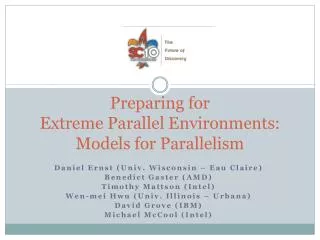
Preparing for Extreme Parallel Environments: Models for Parallelism Daniel Ernst (Univ. Wisconsin – Eau Claire) Benedict Gaster (AMD) Timothy Mattson (Intel) Wen-meiHwu (Univ. Illinois – Urbana) David Grove (IBM) Michael McCool (Intel)
Technical Challenges and Opportunities • The technical challenges for workforce development are very steep • Divergent training structure • Tools for HPC are typically not pedagogically friendly • However, the opportunities are currently growing! • The HPC research focus is heavy on enabling parallelism • The ecosystem of new tools, models, and ideas is rich
Core Questions • What do "new recruits" (such as college grads) need to know to work in HPC? • How can curricula, particularly in Computer Science, be modified to meet those needs? • (What changes? What gets cut out?) • What are the languages, models, and patterns that are both pertinent for future employees and appropriate for pedagogical use?