Solving Simple One-Step Variable Equations: A Comprehensive Guide
This guide focuses on solving simple one-step variable equations. It explains what an equation is—a balanced statement of equality between two quantities—and covers various techniques for isolating variables. You will learn to apply the principles of algebra, including performing the same operation on both sides of an equation to maintain balance. The guide includes examples of linear and non-linear equations, as well as methods for equations involving fractions. Understand how to reduce answers and solve for unknowns effectively.

Solving Simple One-Step Variable Equations: A Comprehensive Guide
E N D
Presentation Transcript
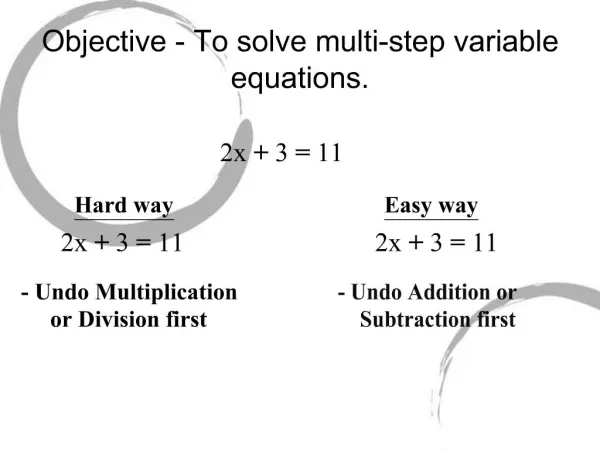
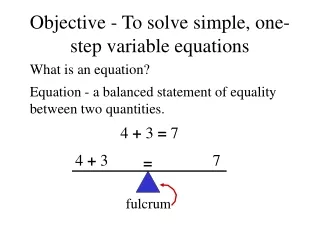
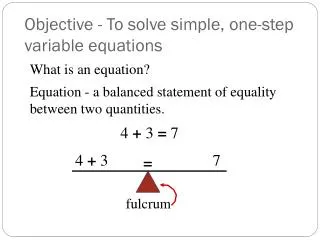
Objective - To solve simple, one-step variable equations What is an equation? Equation - a balanced statement of equality between two quantities. 4 + 3 = 7 4 + 3 7 = fulcrum
4 + 3 7 = - 3 fulcrum
4 7 = fulcrum
4 = 7 fulcrum
4 = 7 fulcrum
4 + 3 7 = - 3 - 3
4 4 = Perform the same operation to both sides to keep the equation balanced.
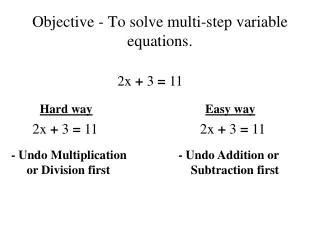
This property can be used to solve variable equations. x + 6 11 = -6 -6 x 5 = Algebraic Approach x + 6 = 11 -6 -6 x = 5
Solve. 1) m + 2 = 10 4) m - 4 = 9 -2 -2 +4 +4 m = 8 m = 13 5) 11 = x - -2 2) x - 4 = 6 +4 +4 -2 -2 x = 10 9 = x 3) x + 7 = 3 6) 8 + y = -6 -7 -7 -8 -8 x = -4 y = -14
Linear vs. Non-linear Linear Equations Non-linear Equations
Rules for Solving Linear Equations 1) Goal: Isolate the variable. 2) Undo operations with their opposite operation. 3) Always do the same thing to both sides of the equation.
Solve. 1) -4 + x = 15 4) - 4 = m + 9 +4 +4 -9 -9 x = 19 -13 = m 2) 7 = x + 13 5) 9 + 7 = x -13 -13 16 = x -6 = x 3) -10 = 6 + x 6) y = 8 - 13 -6 -6 y = -5 -16 = x
Solve. 1) 5x = 35 3) 9 = -3m -3 -3 5 5 -3 = m x = 7 2) 4) (-6) (-6) -72 = x
Acceptable Answers -4k = 14 -4 -4 All answers must be fully reduced! There is nothing improper about an improper fraction!
Solve. 1) 7x = 16 3) 9 = -m 7 7 (-1)9 = -m(-1) -9 = m 2) 4) (-4) (-4) (-2) (-2) k = 16
Solving Equations Involving Fractions Long Way Short Way Easier to multiply by the reciprocal!
Solve. 1) 3) 2) 4)