Navigating Workcamps: Community Development, Worker Welfare, and Accommodation Issues
This outline delves into the complex landscape of workcamps and their implications for community development. It examines the historical context of labor mobility and the increasing need for skilled workers in various regions. Key issues include the differing impacts on host and home communities, the challenges of worker accommodation, and the financial, safety, and social concerns linked to workcamps. The document emphasizes the importance of community readiness for industrial projects and the need for ongoing relationships between communities and industries to ensure mutual benefits.
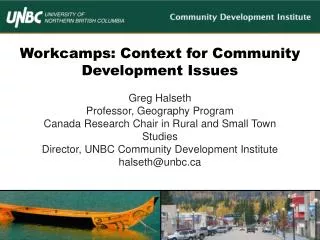

Navigating Workcamps: Community Development, Worker Welfare, and Accommodation Issues
E N D
Presentation Transcript
Outline • Background • Issues • Workcamps: • Issues of General Interest • Differences in Worker Accommodation • Phases • Getting Ready • Discussion
Background I • Always been labour mobility • Increasingly mobile/global capital • Is labour “catching up”?
Background II • Questions of scale: • Geographical • Regional • National • International • Temporal • Daily • Weekly • “Long shifts” • Monthly • Seasonal • Longer
Background III • Transition in work expectations • ‘Golden handcuffs’ of salary replaced by quality of life desires for whole family & multiple employment opportunities
Issues • Workers • Host Communities • Home Communities
Workers & LDLC • Benefits • Financial • Skills, Training • Networks • Experiences from other sectors • Access to a wider range of services/amenities • Concerns • Financial • Safety • Mental health, fatigue, isolation • Household impacts
Host Communities • Increased service demands • Not “counted” in fiscal transfer data • Varies by work camp “type” • Increased local spending • Discretionary areas • Loss of wages to the home community • No investment in volunteer/civic groups • Social disruption
Workcamps – Issues of Context • Context 1 • Cusp of most significant transformation of northern BC in 50 years • Context 2 • Readiness • If projects go – communities must be ready • If projects don’t go – communities must be ready • Context 3 • Attention to our community development foundations • 4 key infrastructure • Context 4 • Imperative of industry • They will get workers
Differences in Worker Accommodation I • Remote camps • Less community impact • Typically highly professional • Proximate camp • Typically highly professional – managed • Can have significant community impact • In town “camps” • Use existing housing, services • Unregulated
Differences in Worker Accommodation II • Camp operator • Open/closed camps • Camp purpose • Construction phase • Operations phase
Discussion III • Continuing points of focus: • Ongoing relationships between community, industry, and businesses • Benefit flows • Tracking responses: • Community • Labour • Industry • Tracking impacts of policy change