A Comparison of Object Oriented Languages in Software Engineering
180 likes | 299 Vues
This presentation explores the key concepts and advantages of object-oriented programming languages (OOPLs) in software engineering, focusing on how they help reduce complexity, enhance development speed, and improve software maintainability. We examine major OOPLs including Smalltalk, C++, Java, and Eiffel, assessing their unique features and efficiencies. With insights from AT&T Bell Labs highlighting significant reductions in development time and effort, this comparison emphasizes the critical role OOPLs play in modern software development and their importance for scalable systems across various applications.


A Comparison of Object Oriented Languages in Software Engineering
E N D
Presentation Transcript
A Comparison of Object Oriented Languages in Software Engineering Written by Mohammed Reza Nami Presented by Mark Simko
Introduction • OOPLs • Help companies reduce complexity • Increase competition in open markets • Speeds up development • Improves maintenance, resusability, modifiability of software
Importance • O-O improves efficiency in development and maintainance • Decreases complexity • Scalable Distributed Systems
Survey • AT&T Bell Labs project using OOPL found • 30% reduction in development time • 20% reduction in staff effort • Able to reuse the code in many other projects
O-O Concepts • Object and Class • Object being a black box • Objects are individual instances of a class
O-O Concepts (con’t) • Properties • Inheritance • Polymorphism • Dynamic Binding • Encapsulation • Information Hiding
Object Oriented Programming Languages • Smalltalk • C++ • Java • Eiffel
Smalltalk • Pure OOL • Run-time binding • Objects can do 3 things • Hold state • Receive a message • Send a message to itself or another object
C++ • Compatible with C • Fast and efficient • Utilizes compile-time binding • High run-time efficiency with small code size • Trades off some power to reuse classes
Java • Portable, can be used on any web-enabled computer • Mixture of C++ and Smalltalk • Syntax of C++ but improved upon it • Garbage Collection • Virtual Machine
Eiffel Language • Portable • Open System • Design by Contract • Automatic Documentation • Multiple Inheritance • Repeated Inheritance • Statically Typed • Dynamically Bound
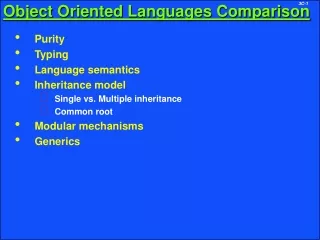
Static Typing • Eiffel – Statically typed • C++ - Statically typed (however the language supports C-style “casts” which really amount to invitations to violate type rules • Java – typed, mostly statically but dynamic typing is required for generic container structures • Smalltalk – Dynamically typed
Compilation Technology • Eiffel – Combination of interpretation and compilation in same environment • C++ - Usually complied • Java – Usually mix of interpretation and “on-the-fly” compilation • Smalltalk – Historically interpreter-based, currently mix of interpretation and compliation
OOPLs and Quality Factors • Eiffel – Efficiency and portability • C++ - Efficiency, maintainability, portability and functionality • Java – Maintainability, Usability, Functionality, and Portability • Smalltalk – Functionality and Maintainability
Automatic Documentation • Eiffel can generate many views, graphical or textual • Class interfaces • Inheritance hierarchies • High level “bubbles and arrows” • Diagrams
Multiple Inheritence • Eiffel – Multiple and repeated inheritance, widely used • C++ Multiple inheritance (though discouraged by many for various problems) • Java – Single inheritance (but multiple interface facility) • Smalltalk – Single Inheritance
Building Infrastructures • Java RMI (Remote Method Invocation) • Communicates between networking and distributed computing • Uses a proxy object • Can have many types • Client can find out what service was returned
Conclusion • Used worldwide for commercial, DoD, and other government projects • Less complexity = increase in maintainability • OOPL must treat the O-O paradigm to gain the benefits