Enhancing Quality and Safety Education in Nursing: A Case Study on Patient Care
120 likes | 248 Vues
This case study template aims to improve quality and safety education for nursing professionals. Utilizing the SBAR (Situation, Background, Assessment, Recommendation) framework, we provide a comprehensive overview of a patient scenario while maintaining confidentiality. It guides users through documenting essential patient details, assessments, prioritized nursing diagnoses, and intervention recommendations. Learning outcomes include understanding safety measures in nursing and the importance of effective communication in patient care continuity.


Enhancing Quality and Safety Education in Nursing: A Case Study on Patient Care
E N D
Presentation Transcript
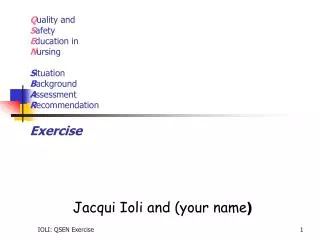
Quality andSafetyEducation inNursing SituationBackgroundAssessmentRecommendationExercise Jacqui Ioli and (your name)
Directions • Using this PowerPoint as a template, create a mini case study. • Fill in the following slides that describe your patient, mention no identifying details for privacy reasons. • We will submit the resulting slides as a team to the QSEN website. • (you may delete this slide)
SBAR • S=Situation • One line that sums up patient • B=Background • The systems assessment • A=Assessment • The bottom line, the priority nursing dx • R=Recommendation • What we are doing for the patient • (you may delete this slide)
S=Situation • Patient is ___years(months/weeks/days) old • ____(male/female) • Presented with (biggest problems) • With past medical history of (top problems) • Here for (main therapy)
Picture • Go to google images and get a nice picture and add it here, then delete this text and title above. Change text and title to something appropriate to your patient. Make this a case study but with NO IDENTIFYING details • Use a reference
Background • Neuro/HEENT/Psych/Pain • everything neck up, includes family • Cardiorespiratory—vital signs, heart, lungs • GI/GU—eats/drinks/pees/poops • MS/Skin—walks/intact • Heme/Endo--labs • Lines/tests/tubes • (this slide may go over to next one, lable header as Background part 2, if normal, chart WNL, if abnormal, chart in detail)
A=Assessment • What’s the bottom line? Better, worse, same? • Priority nursing dx?
R=Recommendation • What are we doing for the patient? • How is your report providing continuity?
The diagnosis • WHAT is the dx? • Brief explanation, 2-3 sent of physiology • State how this affected your patient • WHO gets this dx and WHY? • Brief explanation , 2-3 sent of epidemiology • State how this affected your patient • Use a reference
Safety and the diagnosis • HOW and WHERE do nurses intervene to promote safety within this diagnosis? • Inpatient and in community settings • Brief explanation, at least 3 points • Exactly what was unique for your patient?
Lessons Learned • State 3 things you learned from this patient