Empowering Action Against Gender-Based Violence: A WAGGGS Facilitation Guide
This guide outlines strategies for WAGGGS to address gender-based violence (GBV) at various levels: individual, family, community, cultural, educational, and institutional. Participants will engage in interactive activities designed to enhance their facilitation skills and group dynamics essential for fostering effective discussions. The guide emphasizes the importance of encouraging positive roles in group settings while discouraging behaviors that undermine learning. Join us in creating a supportive environment that challenges GBV and promotes safety and equality for all.

Empowering Action Against Gender-Based Violence: A WAGGGS Facilitation Guide
E N D
Presentation Transcript
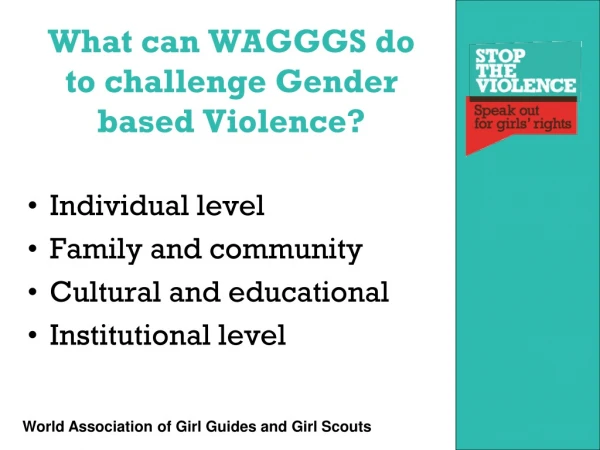
What can WAGGGS do to challenge Gender based Violence? • Individual level • Family and community • Cultural and educational • Institutional level
INSTITUTION COMMUNITY FAMILY EDUCATION CULTURE
Teaching Facilitating Training
Facilitating • Relation • Process • Results
Have a go! Activity
Have a go! - Instructions • Group A and Group B • A – orange, blue, yellow patrols • (Azza & Nefeli) • B – pink, green, red patrols • (Sailee & Pilar) • Within groups divide in pairs. • Each pair will receive an activity from the curriculum. • The activity requires you to show your facilitation skills! • You will have time until 14.50h to prepare. • You will do 5 minutes only of the activity!
Model of group development – Action based model • Forming • Storming • Norming • Performing • Ending
What roles should we encourage to support good group learning? • Listening, • questioning, • stimulating, • participating, • time-keeping, • encouraging • others?
What roles should we discourage as they might undermine group learning? • Disruption, • blocking, • avoiding, • dominating, • doubting, • undermining, • breaking confidentiality • others?