Download
1 / 31
310 likes | 425 Vues
This review article delves into jet quenching and leading-particle suppression phenomena observed in high-energy nucleus-nucleus collisions. The authors discuss the essential physics behind parton energy loss, exploring key mechanisms such as the Landau-Pomeranchuk-Migdal effect and gluon radiation in a nuclear medium. Results from various experiments, including nuclear modification factors at different energies, are analyzed. The implications of energy loss saturation and collective flow effects are discussed, providing insights into the behavior of high-energy partons in a quark-gluon plasma.

E N D
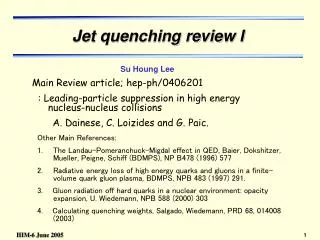
Jet quenching review I Main Review article; hep-ph/0406201 : Leading-particle suppression in high energy nucleus-nucleus collisions A. Dainese, C. Loizides and G. Paic. Su Houng Lee • Other Main References: • The Landau-Pomeranchuck-Migdal effect in QED, Baier, Dokshitzer, Mueller, Peigne, Schiff (BDMPS), NP B478 (1996) 577 • Radiative energy loss of high energy quarks and gluons in a finite-volume quark gluon plasma, BDMPS, NPB 483 (1997) 291. • 3. Gluon radiation off hard quarks in a nuclear environment: opacity expansion, U. Wiedemann, NPB 588 (2000) 303 • 4. Calculating quenching weights, Salgado, Wiedemann, PRD 68, 014008 (2003)
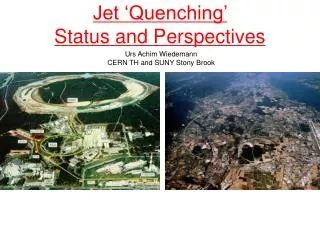
Ject quenching An important parameter to be understood
Section 2 singer@phya.snu.ac.kr> singer@phya.snu.ac.kr> Parton energy loss and collision goemetry +My personal review
Basics: fast charged particle scattering from scattering centers
The high energy electron scatters successively on ordered scattering centers • 2. As a consequence, the electron momenta are on shell
Basics: fast charged particle radiating from scattering centers
For QCD: Non-abelian nature Two parameters characterizing the medium Characteristic phase for coherent radiation Change of variables typically to
Section 3 Leading-particle suppression procedure
Step II: determination of parameters For each parton
Section 4 Results
Azimuthally-differential observables - i Non negligible collective flow effect
Section 5 Discussion
Section 6 Conclusion