Java Inheritance Explained | Types & Examples
Learn about Java inheritance with types like single, multilevel, hierarchical, and multiple inheritance. Includes examples and explanations of super keyword, method overriding, and static keyword in Java.


Java Inheritance Explained | Types & Examples
E N D
Presentation Transcript
Inheritance Visit for more Learning Resources
INHERITANCE Types of inheritance • Single inheritance • Multilevel inheritance • Hierarchical inheritance • Multiple Inheritance(interface Chapter)
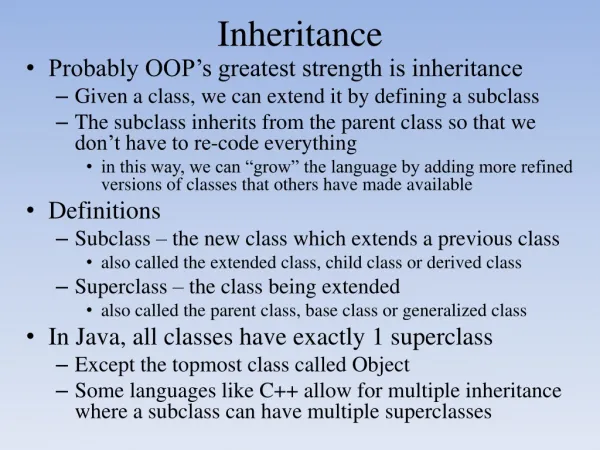
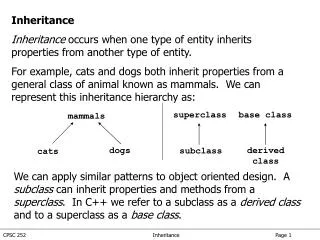
Introduction • In Java inheritance is achieved by extends keyword . • Inheritance allows to derive a new class from an existing one • The existing class is called the parent class, or super class, or base class • The derived class is called the child class or subclass
Inheritance • we use the reserved word extends to establish an inheritance relationship. • Uses :For Method Overriding (so runtime polymorphism can be achieved) • For Code Re-usability class Subclass-name extends Superclass-name { //methods and fields } Vehicle Car
Syntax : class <subclass name> extends <superclass name> { variable declarations; method declarations; } • single inheritance: derived class can have only one parent class public class Student extends Person
EXAMPLE OF INHERITANCE class Parent { public void p1() { System.out.println("Parent method"); } } public class Child extends Parent { public void c1() { System.out.println("Child method"); } } Class Tests public static void main(String[] args) { Child cobj = new Child(); cobj.c1(); //method of Child class cobj.p1(); //method of Parent class } }
Super keyword • In Java super keyword is used by a subclass whenever it need to refer to its immediate super class . • super() to access all (non-private) superclass methods and it must be first statement executed inside subclass constructor. • Super can be used to refer to parent class's methods, instance variables, constructors to call them • Super keyword is useful when overriding and you want to keep the old behavior but add new behavior to it • Syntax: super(); //to call default constructor super(args); // call parent’s constructorsuper.fieldName// access parent’s fieldsuper.methodName(args); // method
Example of super keyword class Vehicle { int speed=50; } class Bike4 extends Vehicle{ int speed=100; void display(){ System.out.println(super.speed);//will print speed of Vehicle now } public static void main(String args[]){ Bike4 b=new Bike4(); b.display(); } }
Multiple inheritance • To remove ambiguity. • To provide more maintainable and clear design.
Multiple inheritance • Multiple inheritance allows a class to be derived from two or more classes, inheriting the members of all parents • Collisions, such as the same variable name in two parents, have to be resolved • Java does not support this directly, rather it uses Interfaces
Overriding methods • Child class can replace the behavior of its parent's methods by redefining them. • Method with same name having different behavior when they are called. • Methods with same name and Return type must be same for calling and to the called. • method must have same parameter as in the parent class. • must be IS-A relationship (inheritance). • Method overriding is used to provide specific implementation of a method that is already provided by its super class.
Rules :Overriding methods • A method declared final cannot be overridden. • A method declared static cannot be overridden but can be re-declared. • If a method cannot be inherited, then it cannot be overridden. • A subclass within the same package as the instance's superclass can override any superclass method that is not declared private or final. • A subclass in a different package can only override the non-final methods declared public or protected.
Static keyword(variables,methods) • We can apply Java static keyword with variables, methods, blocks and nested class. • The static variable can be used to refer the common property of all objects (that is unique for each object) e.g. company name of employees, college name of students etc. • The static variable gets memory only once in class area at the time of class loading. • It makes your program memory efficient. • A static method can be invoked without the need for creating an instance of a class. • static method can access static data member and can change the value of it.
Static keyword(variables,methods) • A static method can be invoked without the need for creating an instance of a class. • static method can access static data member and can change the value of it. • Static method is called by using class name Classname.method() • The static method can not use non static data member or call non-static method directly. class A { int a=40;//non static public static void main(String args[]) { System.out.println(a); } }
Static method class Calculate { static int cube(int x) { return x*x*x; } public static void main(String args[]){ int result=Calculate.cube(5); System.out.println(result); } }
Final class and methods • Preventing overriding the members of superclass to subclass using final keyword. • Defining method using final keyword the method cannot be changed. A class cannot have a subclass if class is final class • class FinalExample{ public static void main(String[] args){ final int x=100; x=200;//Compile Time Error }}
Abstract classes • By using final keyword for Methods which cannot be inherited in subclass • But by using abstract methods redefine methods in subclass, i.e method overriding • Cannot create object for abstract classes. • Abstract method of abstract class must defined in its subclass. • We cannot declare abstract constructor or abstract static methods. Abstract modifier means that the class can be used as a superclass only. • Abstract classes are inherited and abstract methods can be overridden • Used in inheritance hierarchies
Create Abstract Class & Abstract Method public abstract class A1 { abstract void f1(); void f2() { System.out.println("Function - 2"); } } class B extends A1 { @Override void f1() { System.out.println("Function - 1"); } } class MainClass { public static void main(String args[]) { B obj = new B(); obj.f1(); obj.f2(); } }
Nested or inner class • Define a class inside one class is refereed as Inner class. • Class B is defined in class A , class B have access to all data members (including private) of A but class A don't have access to the data members of class B
Dynamic method dispatch • With help of DMD call to overridden method is resolved at run time rather than compile time(runtime polymorphism) • In DMA overridden method is called through the reference variable of a superclass
Dynamic method dispatch For more detail contact us