
The Modern State
E N D
Presentation Transcript
The Modern State HUM 2052: Civilization II Spring 2013 Dr. Perdigao January 28, 2013
Art and Life • Shifts in idea about the state and politics • Machiavelli’s prescription and prophecies about rule • Don Quixote’s attempt to return to a golden age of heroes • Question of place of religion in the modern world • Sacrifice of tradition for new ways of thinking—prescription of how one should live • Representative of shifts in Spanish court, politics and religion • Don Quixote and Candide as reflective of these historical contexts
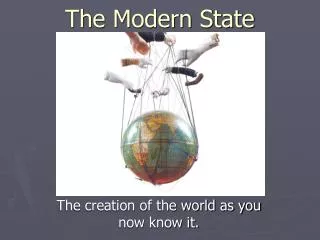
Emergence of the Modern State • Dynastic or national state—emerged from the thirteenth to the seventeenth century • Centralized government—site of absolutism • Invincibility of the king • Courts administered justice, collected taxes, dictated foreign policy, governed publication of books, regulated forms of dress permitted to classes (371) • Republican or constitutional states as alternate model • By 1800, preference for the more participatory system (371) • Shift represented from Machiavelli’s study to new systems of government (and radical shift of power during the period) • Middle-class—bourgeoisie—as part of the system, effected by tax collections, practices of national churches, and military conscription; prosperity dependent up on court-supported foreign and domestic policies (374)
In the Name of Nation and Religion • Ferdinand and Isabella—campaign for purity of blood and religion during their rule fro 1479-1516 • Foundations for Spanish empire and Spanish domination of European affairs throughout the 16th century (374) • Inquisition—church tribunal; interrogation and torture to guarantee faith of converted • Extends to and is representative of the desire for conquest • Exploration: Christopher Columbus’ and Hernando Cortes’ discoveries • Their grandson, Charles (Charles V: 1516-1556), elected Holy Roman emperor, becoming most powerful monarch in Europe • Weakening of empire—Lutheran Reformation in Germany, led to religious struggles between Catholic Spain and Protestant Europe (376) • No development of domestic industry, entrepreneurship, or international commerce; influx of gold led to inflation; financial crises in 1590s and beyond (376)
Competing Systems • France and England emerged as major powers in the wake of Spain’s decline in dominance (379) • Two models of government • England: constitutional monarchy, with Parliament limiting the king’s power, protecting the rights of English citizens • French model emphasized sovereignty of the dynastic state, emphasizing the king’s rule • Divine right of kings—new power to the monarchy, gain control over rebellious feudal lords and resist papal claims of dominance over the French church (379) • With Louis XIV, radical shift in king’s power—king and court ruled without formal consultations with subjects (379) • In the Middle Ages, French monarchs recognized rights of the subjects and consulted local representative assemblies that reflected the three estates • Three estates: clergy, first estate; nobility, second; rest of the population, third • Estates met as circumstances—wars, taxes, local disputes—required and Estates General were summoned by king (379)