
Advancing Conjugated Organic Structures for Enhanced Electronic Properties in Organic Electronics
This study focuses on the generation and analysis of a simple conjugated ligand, which is crucial for the design of functional organic materials in electronic devices. By treating the ligand with Pd(II), a noticeable bathochromic shift was observed via UV-vis spectroscopy. Our current efforts aim to synthesize larger quantities of this ligand to deepen our understanding of its electronic and complexation behavior. We propose to incorporate this substructure into discotic and cruciform motifs, anticipating significant electronic responses that could enhance organic electronics components.

Advancing Conjugated Organic Structures for Enhanced Electronic Properties in Organic Electronics
E N D
Presentation Transcript
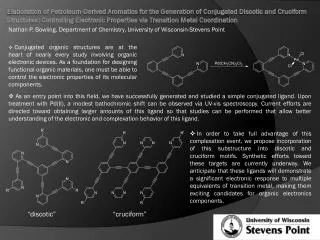
Nathan P. Bowling, Department of Chemistry, University of Wisconsin-Stevens Point Conjugated organic structures are at the heart of nearly every study involving organic electronic devices. As a foundation for designing functional organic materials, one must be able to control the electronic properties of its molecular components. • As an entry point into this field, we have successfully generated and studied a simple conjugated ligand. Upon treatment with Pd(II), a modest bathochromic shift can be observed via UV-vis spectroscopy. Current efforts are directed toward obtaining larger amounts of this ligand so that studies can be performed that allow better understanding of the electronic and complexation behavior of this ligand. Elaborationof Petroleum-Derived Aromaticsfor the Generationof ConjugatedDiscoticand Cruciform Structures: Controlling Electronic Propertiesvia Transition Metal Coordination • In order to take full advantage of this complexation event, we propose incorporation of this substructure into discotic and cruciform motifs. Synthetic efforts toward these targets are currently underway. We anticipate that these ligands will demonstrate a significant electronic response to multiple equivalents of transition metal, making them exciting candidates for organic electronics components. “discotic” “cruciform”