NERVOUS SYSTEM
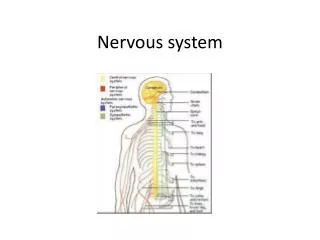
The nervous system plays a critical role in maintaining homeostasis through rapid response and regulation. Comprising neurons and neuroglia, it enables communication within the body via action potentials. Key functions include sensory detection, integrative processing, and motor responses facilitated by sensory and motor neurons. The structure of the nervous system encompasses the brain, spinal cord, cranial and spinal nerves, and various specialized receptors. Understanding this system is vital for grasping how the body responds to internal and external stimuli.


NERVOUS SYSTEM
E N D
Presentation Transcript
NERVOUS SYSTEM HONORS ANATOMY & PHYSIOLOGY
excitable characteristic of nervous tissue allows for generation of nerve impulses (action potentials) that provide communication & regulation of most body tissue. • together with endocrine system: responsible for maintaining homeostasis Nervous Tissue & Homeostasis
NERVOUS ENDOCRINE • rapid responder • action potentials • slow, prolonged response • releases hormones Differences in Nervous & Endocrine Control of Homeostasis
total mass of 2 kg (~3% of total body mass) • Skull • Spinal Cord • Spinal Nerves • Cranial Nerves • Ganglia • Enteric Plexus • Special Senses & other Sensory Receptors Structures of the Nervous System
3 basic functions: • Sensory • Integrative • Motor Functions of the Nervous System
sensory receptors detect internal & external stimuli • sensory (afferent) neurons carry this sensory information to spinal cord & brain thru cranial & spinal nerves Sensory Function
integrate: process • nervous system takes information from sensory neurons & processes that information, analyzes it, stores some of it & makes decisions for appropriate responses • served by interneurons (connect 1 neuron to another neuron • Perception: • conscious awareness of sensory stimuli • occurs in brain Integrative Function
served by motor (efferent) neurons • carry info from brain/spinal cord effectors (muscle or gland) thru cranial or spinal nerves • results in muscles contraction or gland secreting Motor Function
What terms are given to neurons that carry input spinal cord & brain? • What terms are given to neurons that carry output out of the brain & spinal cord? Quick Quiz
2 cell types • Neurons • Neuroglia Histology of the Nerrvous System
nerve cells that possess electrical excitability: • ability to respond to a stimulus & convert it into an action potential • stimulus: any change in environment that is strong enough to initiate an action potential Neurons
electrical signal that propagates along surface of neurolema (membrane) • begins & travels due to movement of ions between interstitial fluid & inside of neuron thru specific ion channels • once begun it travels rapidly @ constant strength Action Potential
contains nucleus, cytoplasm, typical organelles, • + Nissl bodies clusters of RER • make materials for: • growth of neuron • regenerate damaged axons in PNS Parts of Neuron: Cell Body
general term for any neuronal process or extension that emerges from cell body • most neurons have 2: • Dendrites • Axons Nerve Fiber
“little trees” • input portion of neuron • usually, short, tapering, highly branched • their cytoplasm contains Nissl bodies, mitochondria Dendrites
propagates action potentials • another neuron • muscle fiber • gland cell Axon
joins cell body @ cone-shaped elevation: axon hillock • part of axon closest to hillock = initial segment • jct of axon hillock & initial segment where action potential arises so is called the trigger zone Parts of an Axon
axoplasm: cytoplasm of an axon • axolemma: plasma membrane of axon • axon collaterals: side branches along length of axon (most @ 90°) • axon terminals: axon divides into many fine processes Parts of an Axon
site of communication between 2 neurons or between a neuron & effector cell • synaptic end bulbs: tips of some axon terminals swell into bulb-shaped structures • synaptic vesicles: store neurotransmitter • many neurons have >1 neurotransmitter, each with different effects on postsynaptic cell Synapse
2 types: • for moving materials from cell body axon terminals • slow • 1-5 mm/d • replenishes new axoplasm to developing or regenerating axons • fast • 200 – 400 mm/d • moves materials to/from cell body • organelles or membranes needed in axon terminal Axonal Transport
Functional Classification Structural Classification • Sensory • Interneurons • Motor • use # processes extending from cell body • Multipolar neurons • Bipolar neurons • Unipolar neurons Types of Neurons
several dendrites with 1 axon • includes most neurons in brain & spinal cord Multipolar Neurons
1 main dendrite & 1 axon • retina, inner ear, olfactory area of brain Bipolar Neuron
are sensory neurons that begin in embryo as bipolar • during development axon & dendrite fuse then divide into 2 branches (both have characteristic structure & function of an axon) • 1 branch ends with dendrites (out of CNS) • 2nd branch ends in axon terminal (in CNS) • cell bodies of most found in ganglia Unipolar Neuron
found in cerebellum Purkinje Cells
in cerebral cortex of brain Pyramidal Cells
~50% vol of CNS • “glue” • do not generate or propagate action potentials • multiply & divide in mature nervous systems • glioma: • brain tumors derived from glial cells • very malignant, grow rapidly Neuroglia (Glia)
ASTROCYTES • OLIGODENDROCYTES • MICROGLIA • EPENDYMAL CELLS Glial Cells of the CNS
star-shaped • largest & most numerous of glial cells • functions: • physically support neurons • assist in blood-brain-barrier (bbb) • in embryo: regulate growth, migration, &interconnections between neurons • help maintain appropriate chemical environment for propagation of action potentials Astrocytes
“few trees” • smaller & fewer branches than astrocytes • Functions: • form & maintain myelin sheath on axons in CNS • 1 oligo. myelinates many axons Oligodendrocytes
small cells with slender processes giving off many spine-like projections • function: • phagocytes • remove cellular debris made during normal development • remove microbes & damaged nervous tissue Microglia
single layer of cuboidal to columnar cells • ciliated & have microvilli • function: • line ventricles of brain & central canal of spinal cord • produce, monitor, & assist in circulation of cerebrospinal fluid (CSF) • form bbb Ependymal Cells
Schwann cells • Satellite cells Neuroglial Cells of the PNS
functions: • myelinate axons in PNS • 1 Schwann cell myelinates 1 axon • participate in axon regeneration Schwann Cells
flat cells that surround cell bodies of neurons in PNS ganglia • functions: • structural support • regulate exchange of materials between neuronal cell bodies & interstitial fluid Satellite Cells
myelin sheath: made up of multilayered lipid & protein (plasma membrane) covering • function: • electrically insulates axon • increases speed of nerve impulses Myelination
gaps in myelin sheath • 1 Schwann cell wraps axon between nodes of Ranvier Nodes of Ranvier
amount increases from birth to maturity • infant‘s responses slower & less coordinated as older child or adult in part because myelination is a work in progress thru infancy Myelin