Download
1 / 28
280 likes | 405 Vues
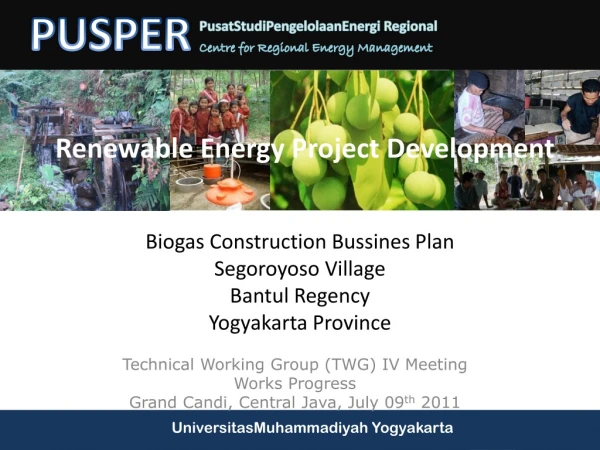
The TWG IV project aims to implement renewable energy development in Sei Siarti and Selat Beting Village, North Sumatera. This initiative under the CASINDO program focuses on Solar Home Systems (SHS), providing decentralized solar energy solutions for remote areas. SHS will not only enhance lighting but also improve access to information and create new local business opportunities. The project includes thorough market and demographic analyses to ensure effective implementation and community benefits, with a focus on enhancing the quality of life while promoting sustainable energy practices.

E N D
Site Survey Sei Siarti and Selat Beting Village is the name of chosen for location of the implementation of renewable energy development projects in the program CASINDO of North Sumatera . Administratively, the village of Sei Siarti and Selat Beting is located in the district Labuhan Batu , Panai Tengah Regency , North Sumatera province.
Market Analysis • Demographic profile of selected location
SHS installed in decentralization (one house a plant, so it does not require a distribution network) SHS ideal for remote areas or areas that are not included PT PLN distribution network. Currently the use of SHS is not merely just for lighting but can also be used for television systems. In Indonesia, demand for this system started to show increased since the 2000s along with a vigorous campaign for urban green energy and the removal of fuel subsidies by the government in 2005, which makes the cost of generator operation, especially in the area (island) remote becomes increasingly expensive and lead to price PLTS increasingly competitive.
Social benefits to adopting the proposed technology are: 1. Reducing the burden of women to collect firewood and facilitates alternative additional activities to fill the time available, especially for female 2. Provide lighting (lamps) with better quality, so the hour long learning and more activities. 3. Improving access to information (radio, TV). 4. Creating new business opportunities in the village by becoming a distributor, and service centers that can be done by cooperatives. 5. Creating employment in the village, as the sales center, and service centers that require local power.
Technical Feasibility The capacity of a SHS used can vary depending on user needs, ranging from 50 WP, 80 WP to 100 WP. SHS installed system has a power output and the use of lighting in different amounts. In addition to the total use of lights and power output, system SHS has the kind of output voltage AC and DC.
Component SHS • Solar Panels, changing intensity of sunlight into electrical energy. Solar panel / solar cell produces a stream that is used to fill baterai. • Controler, which is its function as a regulator of both the flow of electrical current that flows in and out / be used. • Battery, its function is to save electricity. • Inverter, its function if the electrical equipment / electrical loads using alternating - (AC), the PLTS system because its function is required to use an inverter that converts direct current into alternating power - behind. In operation, the inverter also requires electrical power consumption to run
Financial Analysis Operating Costs