Database Management
Database Management. Chapter 4. Chapter Objectives. Describe why databases have become so important to modern organizations Describe what database and DBMS are and how they work Explain four emerging database trends: Client-server computing Object-oriented databases Data mining

Database Management
E N D
Presentation Transcript
Database Management Chapter 4
Chapter Objectives • Describe why databases have become so important to modern organizations • Describe what database and DBMS are and how they work • Explain four emerging database trends: • Client-server computing • Object-oriented databases • Data mining • Integrating Web applications
Database Management for Strategic Advantage • We live in the Information Age • Information used to make organizations more productive and competitive • Databases used to support business operations
Databases Before the Use of Computers • Data kept in books, ledgers, card files, folders, and file cabinets • Long response time • Labor-intensive • Often incomplete or inaccurate
The Database Approach • Database-management system (DBMS) • Interact with the data in databases • Entity: something you collect data about • Field: one characteristic of an entity • Record: collection of fields that describe one occurrence of an entity • Entities stored in tables • One record per row • One field per column
The Database Approach • DBMS replaced file processing approach • Reduced data redundancy • Reduced program dependence • Databases typically consist of several tables • Tables can be linked together
Key Database Issuesand Activities • Entering and Querying Data • Creating Database Reports
Entering and Querying Data • Use a form for data entry • Use queries to retrieve information • Structured Query Language (SQL) • Query by example (QBE)
Creating Database Reports • Report • A compilation of data organized and produced in printed format • DBMS packages include a report writer • Graphics can be added • Can be automatically updated by linking to data
Data Structure • Data model • A representation of the entities and their relationships • Primary key • An attribute or combination of attributes • Uniquely identifies each record
Data Type • Each field is assigned a type • Text, number, date, etc. • Data types help the DBMS • Organize and sort the data • Do calculations • Allocate space • Data dictionary • A repository of information about the data • Key fields, data types, valid values, etc.
Database Management Systems Approaches • Models of the relationship between entities in a database • Hierarchical • Network • Relational
The Hierarchical Model • Models entities in a parent-child relationship • One-to-many relationships • Parent entities can have many child records • Each child can have only one parent • Inadequate model for many databases • Not always clear which entity is the parent and which is the child
The Network Model • More flexible than the hierarchical model • Many-to-many relationships • Allows multiple children and parents • Complex databases become too cumbersome with this model
The Relational Model • Views entities as two-dimensional tables • Records are rows • Attributes are columns • Tables can be linked • Supports one-to-many, many-to-many, and one-to-one relationships
Normalization • A technique used to make complex databases more efficient • Break one large table into several smaller tables • Eliminates all repeating groups in records • Eliminates redundant data
Associations • Relationships among the entities in the data structures • Three types • One-to-one • One-to-many • Many-to-many • Relationships set by placing primary key from one table as foreign key in another • Creates “acceptable” redundancy
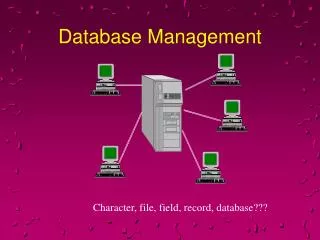
Recent Developments Affecting Database Design and Use • Databases and Client-Server Computing • Server holds the actual database • Clients hold software to work with the database • Object-Oriented Databases (OODBs) • Treat tables, queries, etc., as reusable objects
Recent Developments Affecting Database Design and Use • Data Mining (On-Line Analytical Processing) • Drill down from summary data to detailed data • Data Warehouses/Data Marts • Integrates many large databases into one repository • Linking Web Site Applications to Organizational Databases • Users have Web view to organizational database • Improves customer contact and service • Adds security as a concern
Effective Management of Databases • Database Administrator (DBA) • Responsible for the development and management of an organization’s databases • Works with systems analysts on design • Works with users and managers on managerial and organizational issues • Responsible for implementing security features