Download
1 / 27
270 likes | 413 Vues
Dive into the world of quadratic functions, where you will learn to graph parabolas using vertex form and intercept form. This lesson highlights essential concepts including the definition of a quadratic function, the significance of the vertex, and the axis of symmetry. Explore transformations of the basic quadratic function and analyze graphs with various examples. You'll practice identifying the vertex and guiding lines, ensuring a solid understanding of how quadratics behave. Perfect for students and math enthusiasts eager to master graphing quadratics!

E N D
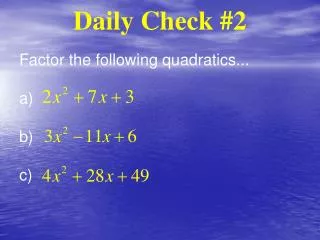
Daily Check #2 Factor the following quadratics... a) b) c)
Questions over hw? He didn’t see the ewe turn!
Math IIDay 5 (1-10-11) • Standard MM2A3 • b – Graph quadratic functions as transformations of the function f(x) = x2 • Today’s Question: • How to we graph a parabola using vertex form?
3.2 Graphing Quadratic Functions in Vertex or Intercept Form • Definitions • 3 Forms • Graphing in vertex form • Examples • Changing between eqn. forms
Quadratic Function • A function of the form y=ax2+bx+c where a≠0 making a u-shaped graph called a parabola. Example quadratic equation:
x – intercepts (-3,0) (1,0) y – intercept (0,6) vertex (-1,8) Interval of Increase Interval of Decrease
Vertex- • The lowest or highest point of a parabola. Vertex Axis of symmetry- • The vertical line through the vertex of the parabola. Axis of Symmetry
Example Websitelet’s look at some parabolasscroll all the way down to the bottom examples • Quadratics in Action
Vertex Form Equation y=a(x-h)2+k
Vertex Form Equation y=a(x-h)2+k • If a is positive, parabola opens up If a is negative, parabola opens down. • The vertex is the point (h,k). • If a > 1 the parabola gets skinny • If a < 1 the parabola gets fatter • The vertex is the point (h,k). • The axis of symmetry is the vertical line x=h.
Tip for the Vertex • (x – h)2 + k • The y doesn’t lie • But the x does – we must change its sign. • (x – 3)2 + 7 • Vertex will be at (3,7)
Now You Try. • Where is the vertex of • (x – 2)2 + 8 • (x + 5)2 + 7 • (x + 4)2 - 2 (2,8) (-5,7) (-4,-2)
Vertex Form • Each function we just looked at can be written in the form (x – h)2 + k, where (h , k) is the vertex of the parabola, and x = h is its axis of symmetry. • (x – h)2 + k – vertex form
Hold Up…..Wait a minutelet’s go back to that websiteand identify equations http://www.analyzemath.com/quadraticg/quadraticg.htm
Example: Graphy=-.5(x+3)2+4 • a is negative (a = -.5), so parabola opens down. • Vertex is (h,k) or (-3,4) • Axis of symmetry is the vertical line x = -3 • Table of values x -.5(x+3)2+4 y (x, y) Vertex (-3,4) -1 -.5(-1+3)2+4 2 (-1,2) -2 -.5(-2+3)2+4 2 (-2,3.5) -4 -.5(-4+3)2+4 2 (-3,3.5) -5 -.5(-5+3)2+4 2 (-4,2) (-4,3.5) (-2,3.5) (-5,2) (-1,2) x=-3
Let’s do together • Analyze and Graph: y = (x + 4)2 - 3. (-4,-3)
Now you try one! y=2(x-1)2+3 • Open up or down? • Vertex? • Axis of symmetry? • Table of values?
(-1, 11) (3,11) X = 1 (0,5) (2,5) (1,3)
Classwork Page 67 #11 - 18
Homework Book Page 65 #13-18