Download
1 / 13
130 likes | 244 Vues
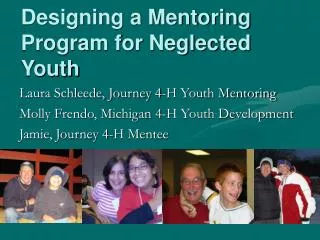
This document outlines the framework for a mentoring program aimed at reducing delinquent behavior in court-involved youth. The Journey 4-H Mentoring initiative partners with the Ottawa County Family Court to match youth with screened volunteers who commit to engaging mentoring relationships over a period of at least 18 months. The program emphasizes mentor training, targeted recruitment, and ongoing support to ensure successful matches. Through skills development, community involvement, and enhanced family communication, mentors provide vital support to youth and their families.

E N D
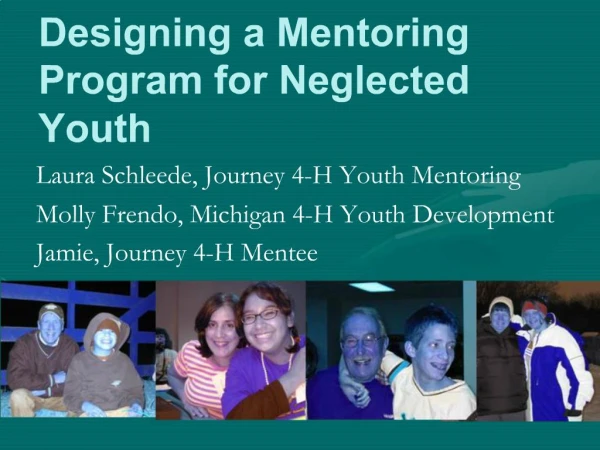
1. Designing a Mentoring Program for Neglected Youth Laura Schleede, Journey 4-H Youth Mentoring
Molly Frendo, Michigan 4-H Youth Development
Jamie, Journey 4-H Mentee
2. Jamie’s Story
3. Journey 4-H Youth Mentoring Partnership with Ottawa County Family Court, Juvenile Services
Matches court involved youth with screened volunteers
Volunteers complete 12 hours of pre-match training
Matches commit to meet for at least two hours a week for a minimum of eighteen months
Mission is to reduce frequency and severity of delinquent behavior by matching court involved youth with a caring adult friend and role model
4. Changing Lives Mentors provide support to youth and families
Mentors teach skills
Mentors and program staff provide:
Youth with supervision during critical after-school hours
Referrals for needed services
A respite for parents
Mentors help youth learn how to communicate better within the family, at school and socially
Exposure to community service
5. Mentor Recruitment Targeted recruitment of stable adults
Emphasis on long term commitment
Consider people with history in helping professions
Communicate need for flexibility
6. Mentor Screening
Be selective
Mentors need to be flexible and able to adapt to circumstances
Patience- not pushy
Complete background check
Interview and references are crucial
7. Possible Interview and Reference Questions Ask references to comment on the candidate’s ability to commit to a long term match
Ask the reference how the candidate handles unexpected events and changes
Ask candidate to respond to various role play scenarios
Ask the volunteer how they role model good behavior (patience, communication, etc.)
8. Mentor Training Mentors with less than two hours of pre-match training report the lowest levels of closeness and supportiveness with their mentees.
(Herrera, Sipe & McClanahan, 2000; Rhodes 2002)
Mentors with six or more hours of pre-match training report the strongest relationships.
(Herrera., Sipe & McClanahan, 2000; Rhodes 2002)
Training provides mentoring staff with an opportunity to learn more about volunteers and understand areas in which the mentor may need additional support or training
9. Mentor Training Training topics
Reporting abuse and neglect
Boundaries and program policies
Communication
Youth development
Building relationships
Cultural sensitivity
Understanding the role of a mentor
10. Matching Complete comprehensive intake with youth to get to know the youth and their needs
Consider compatibility (interests, personality types, skills)
Match meeting
Set clear goals/ contract
Provide an initial activity for the match to complete together
11. Match Support Communicate with mentor, youth and family on a regular basis
Progress reports
Phone
Email
Face to face
Ensure that staff are trained and aware of resources for families
Provide social recreational, educational and service activities for matches
Ask for youth feedback and ideas
Provide safe opportunities for youth leadership
12. Match Closure Plan ahead- this is a process, not a meeting
Talk about future contact
Provide an opportunity for mentors and mentees to share feedback
Determine if youth or mentor want to be re-matched
13. Jamie: My Life Now Trampoline
Your time and energy is worth it
Thank you for doing what you do!
14. Questions?
Laura Schleede
Program Assistant
Journey 4H Youth Mentoring
Ottawa County MSU Extension
333 Clinton
Grand Haven, MI 49417
616.846.8250
nordheim@msu.edu
Molly Frendo
Associate Program Leader
4H Mentor Michigan Initiative
MSU Extension
160 Agriculture Hall
E. Lansing, MI 48823
517.432.7606
frendo@anr.msu.edu