Evaluating IBE Criteria Flaws in Criterion Development for Bioequivalence Studies
110 likes | 231 Vues
This document highlights the critical flaws in the IBE criteria used in the development of bioequivalence standards. It discusses the ratio of expected squared differences in test versus reference administrations, issues with aggregate criteria such as means and variances, and restrictions on individual terms lacking mathematical and clinical support. Furthermore, it examines the historical context of FDA approvals for immediate-release coated oral tablets and presents findings from a simulation revealing significant variability in test/reference ratios among generic and brand tablets, indicating the need for reevaluation of generic standards.


Evaluating IBE Criteria Flaws in Criterion Development for Bioequivalence Studies
E N D
Presentation Transcript
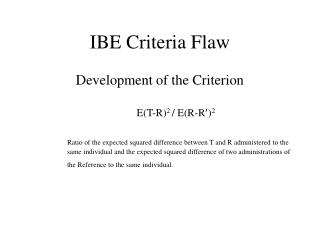
IBE Criteria Flaw Development of the Criterion E(T-R)2 / E(R-R)2 Ratio of the expected squared difference between T and R administered to the same individual and the expected squared difference of two administrations of the Reference to the same individual.
IBE Criteria Flaw Development of the Criterion Aggregate Criterion • Difference in Means • Difference in Variances • Subject-by-Formulation Term • Scaled by Reference Variance • Added without justification: T/R within 0.80-1.25
IBE Criteria Flaw Development of the Criterion Restrictions on Individual Terms • Not supported by the mathematics • Not supported by clinical/scientific considerations • Has undesirable consequences
IBE Criteria Flaw Immediate-release, Coated Oral Tablet FDA approval early 1980s Two-way 10-subject crossover study Single one-tablet fasted dose Generic vs. Brand
IBE Criteria FlawSimulation (100,000 trials) T/R=1.05 for 80% of Brand tablets T/R=3.50 for 20% of Brand tablets Generic within-subject cv = 20% Brand within-subject cv = 30% Replicated study in 30 subjects Only 30% of the time T/R was within 0.80-1.25 Only recourse is make a more variable generic