Introduction to ENERGY FLOW
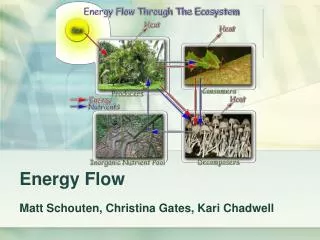
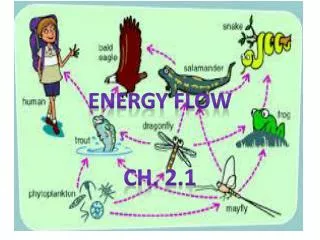
This overview defines essential components of ecosystems—organisms, populations, and communities—and explains energy flow through food chains. It highlights producers, consumers (herbivores, carnivores, and omnivores), and decomposers in food webs and their roles in recycling nutrients. The sun is identified as the ultimate energy source, with photosynthesis being crucial for converting solar energy into food. The concept of trophic levels illustrates how energy is transferred and lost among organisms, underscoring the interconnectedness of life and the environmental balance.

Introduction to ENERGY FLOW
E N D
Presentation Transcript
Introduction to ENERGY FLOW ECOSYSTEMS and FOOD CHAINS
What is an ecosystem? • Habitat – place where an organism lives. • Population – group of organisms from the same species. • Community – group of organisms from several species. • Ecosystem – a community and all of the physical aspects of a habitat.
Ecosystem Community Population Organism
sun eclipse with palm the ultimate energy source is the SUN!!!
How does the sun’s energy enter the biological world? photosynthesis Energy Flow
consumer 2 sunlight producer consumer 1 Energy Flow • The sun’s energy flows into organisms that can change the sunlight into food then into organisms that eat them. • This flow is:
consumer 2 sunlight producer consumer 1 PRODUCERS • Producers make their own food. They can also be called autotrophs. • Ex. Plants, algae and some bacteria
consumer 2 sunlight producer consumer 1 CONSUMERS • Consumers eat something else. They also are called heterotrophs. • Examples: deer, rabbits, cows, mice, lions, humans, hawks, snakes
Herbivores eat plants. They can be called primary consumers Ex. Cows, caterpillars, bunnies consumer 2 sunlight producer consumer 1 HERBIVORES
Carnivores eat meat and can be called secondary consumers. Ex. tigers, wolves, snakes, hawks consumer 2 sunlight producer consumer 1 CARNIVORES
A “top” carnivore is a tertiary consumer. They are at the top of the food chain. Ex. whale eating a sea lion or hawk eating a snake. consumer 2 sunlight producer consumer 3 consumer 1 TOP CARNIVORES
OMNIVORES • Omnivores eat meat and plants. • They are considered secondary consumers. • Ex. bears and humans
They are eaten. YUMMMM! They decay. SMELLY! Where do allthe dead things go? decomposer detritivore What’s the difference?Is it just a matter of taste?
DETRIVORES: feed on the remains of dead plants and animals and other dead matter (detritus) Crabs, mites, earthworms, snails Detritivore vs Decomposers
DECOMPOSERS: break down dead organic matter Bacteria & fungi Detritivore vs Decomposers
Why would they be called the environmental “recyclers”? decomposer consumer 3 consumer 2 sunlight producer consumer 1 Detritivores and Decomposers
consumer 3 consumer 2 producer consumer 1 Food Chains & Food Webs • Organisms in ecosystems transfer energy from organism to organism in a graphic organizer known as trophic levels. 3 4 2 1
consumer 3 consumer 2 producer consumer 1 The Path of Energy • ARROWS on a food chain describe this path of energy. • Notice that the arrows point from the organism being eaten to the organism that is eating it.
consumer 3 consumer 2 producer consumer 1 Food Chains & Food Webs • Energy is “lost” at each trophic level as a result of the activities of the organisms such as metabolism. • Only 10% of the energy is actually passed on to the next level.
What vital “recycler” is not shown in this food chain? consumer 3 consumer 2 producer consumer 1 Food Chains & Food Webs
decomposer consumer 3 consumer 2 producer consumer 1 Food Chains & Food Webs • If all of the snakes in this chain died, what would happen to the hawk? • To the decomposers?