Understanding Equilibrium Constants in Chemical Reactions
Learn to calculate equilibrium concentrations with examples and formulas for Kc and Kp. Understand how to handle solids and liquids in equilibrium expressions.

Understanding Equilibrium Constants in Chemical Reactions
E N D
Presentation Transcript
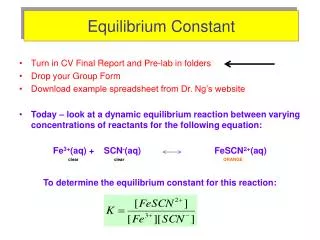
Example H2 + F2 2HF The equilibrium constant for the reaction above is found to be 2.1 x 10³ at a specific temperature. At equilibrium, the concentrations of both hydrogen and fluorine are found to be 0.0045 M. What is the equilibrium concentration of hydrogen fluoride?
Example • A mixture of 5.00 x 10⁻³ mole of H2 and 1.00 x 10⁻² mole of I2 is placed in a 5.00L container and allowed to come to equilibrium. Analysis of the equilibrium mixture shows the concentration of HI is 1.87 x 10⁻³ M. Calculate the Kc at 448°C for this reaction. H2 + I2 2HI
Example • Sulfur trioxide decomposes at high temperatures in a sealed container as shown: 2SO3 2SO2 + O2 Initially the vessel is charged at 1000K with 6.09 x 10⁻³ M SO3. At equilibrium the SO3 concentration is 2.44 x 10⁻³ M. Calculate the Kc at 1000K.
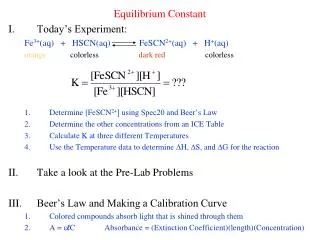
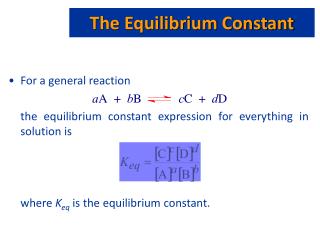
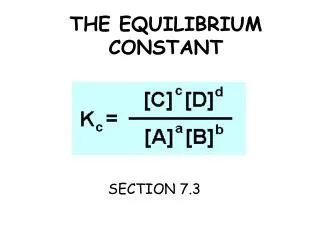
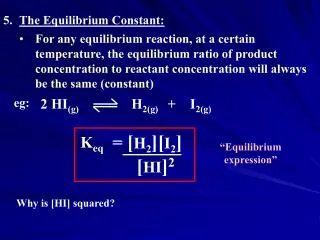
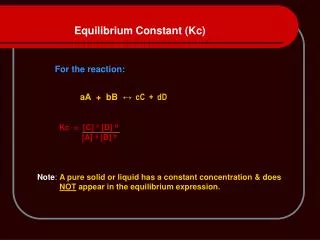
Kc and Kp • When concentration is expressed in M use Kc as the constant. • When concentration is expressed in atm use Kp • aA cC + dD • Kp = Pcc PDd / PAa
Example • The reaction for the formation of nitrosyl chloride 2NO(g) + Cl2(g) 2NOCl(g) was studied at 25°C. The pressures at equilibrium were found to be PNOCl= 1.2atm, PNO = 5.0x10⁻²atm, and PCl = .3atm. Calculate the Kp for this reaction.
Kp from Kc • Kp = Kc (RT)n • n – total coefficients of gaseous products minus total coefficients of gaseous reactants • R = .0821 L atm/mol K
Example • The Kc for the reaction N2 + 3H2 2NH3 is .105. Calculate the Kp at 472°C.
Solids and Liquids • The concentrations of pure solids and liquids in a reaction does not really change • They are not included in the equilibrium expression
Example • Write the equilibrium expression for: CO2(g) + H2(g) CO(g) + H2O(l) SnO2(s) + 2CO(g) Sn(s) + 2CO2(g)