Optimizing Acoustic Horn Shapes to Minimize Reflection Using Fixed Mesh Methods
This study addresses the shape optimization of acoustic horns to minimize reflection using a fixed mesh approach. Traditional shape optimization relies on a moving mesh for precision but is hindered by complex mathematics and costly calculations. We implemented a shape representation through a binary function to define horn geometry and modeled wave propagation with finite-element approximation of the Helmholtz equation. Utilizing a quasi-Newton method with BFGS updates, our optimization achieved a remarkable reduction in reflection from 44% at 350 Hz to only 0.2% after 7 iterations.

Optimizing Acoustic Horn Shapes to Minimize Reflection Using Fixed Mesh Methods
E N D
Presentation Transcript
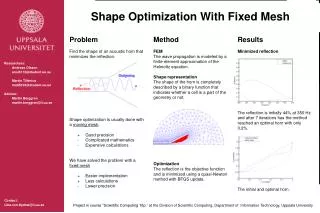
Problem Find the shape of an acoustic horn that minimizes the reflection. Shape optimization is usually done with a moving mesh. + Good precision - Complicated mathematics - Expensive calculations We have solved the problem with a fixed mesh + Easier implementation + Less calculations - Lower precision Method FEM The wave propagation is modeled by a finite-element approximation of the Helmoltz equation. Shape representation The shape of the horn is completely described by a binary function that indicates whether a cell is a part of the geometry or not. Optimization The reflection is the objective function and is minimized using a quasi-Newton method with BFGS update. Results Minimized reflection The reflection is initially 44% at 350 Hz and after 7 iterations has the method reached an optimal horn with only 0.2%. The initial and optimal horn. Researchers: Andreas Olsson anol5113@student.uu.se Martin Tillenius mati5023@student.uu.se Advisor: Martin Berggren martin.berggren@it.uu.se Shape Optimization With Fixed Mesh Contact: Lina.von.Sydow@it.uu.se Project in course ”Scientific Computing 10p.” at the Division of Scientific Computing, Department of Information Technology, Uppsala University