Enhancing Forecast Accuracy and Website Usability: A Comprehensive Improvement Proposal
This proposal outlines strategies for improving weather forecasting accuracy and enhancing website usability. Key modifications include shifting to a 3-category probabilistic shading system, establishing clear calibration methods, and ensuring data is up-to-date. A dedicated Website Task Force will focus on improving navigation and the visibility of extended forecasts. The aim is to integrate various forecasting models, facilitate access to explanatory materials, and enhance user interaction with data. This comprehensive approach targets better communication with users in sectors like energy and agriculture.

Enhancing Forecast Accuracy and Website Usability: A Comprehensive Improvement Proposal
E N D
Presentation Transcript
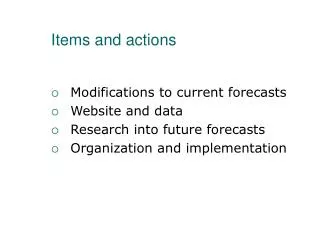
Items and actions • Modifications to current forecasts • Website and data • Research into future forecasts • Organization and implementation
Modification to current forecasts • Replace deterministic forecast • 3-category probabilistic shading + contouring • calibrate • shading limits and “no forecast” • skill measures • aesthetics and website • Canada map + skill is 1st order with links: • 3 category full probabalistic • skill measures • data • …..
Proposal (see also Kharin report) • calibrate • shade > 40% • no shade => “no forecast” or “other” • map over Canadian region • no pole • no US • only 1 shading bar (see examples) • add skill map • links to • full probability forecasts • skill scores • data • mean and s
Details • Calibrate using Kharin method • Shade above 40% • no-shade = “no-forecast” or “other” • attach skill measure (eg. % correct) • links to: • full probability forecasts • other skill measures • past forecasts etc., but better web design
Website and data • monthly, seasonal forecasts mislabelled under “modelling and analysis” • need button on weatheroffice page which at least indicates “extended forecasts” • Actions • inform Chas Lin, D. Whelpdale, and others .. • set up Website Task Force Monthly and Seasonal forecasts
Website task force • set up task force for Monthly and Seasonal Forecast section of website • propose a (re) design of MSF section • separate section for MSF – “new” forecast on main page • cleaner look, hierarchy of links to: • 3-panel probability forecasts • verification information • up to date explanatory information • data • etc. • produce an explicit proposalfor MSF section • including review process to keep up to date • set time limits for design/proposal • lobby and demand/promote action
Forecast data task force • mechanism to keep forecast data up to date • link to explanatory material on HFP2 • provide additional information • basic statistics, mean and s • other variables for applications • energy • agriculture • focus for interaction with data users
Other forecasts • HFP2+ and CMC seasonal forecast evolution • extend HFP2 to present • add additional forecast models (AGCM4, CHFP1, …) • Subseasonal • CCCma participation • initially in Bin Wang intercomparison • CCCma/RPN “research plan”, resources • GLACE2/GOAPP • surface initialization effects • part of GOAPP in conjunction with GUELPH • GLACE2 intercomparison
CHIP2 • CHFP = HFP but 1-tier, coupledmulti-season forecast project • GOAPP Theme II project • contribution to WGSIP “Climate-system Intercomparison Project” i.e. their CHFP • basis for WGDIP/WGCM/CMIP5 decadal climate forecasts • how do we plan for and exploit CHFP?
CHFP/coupled forecasting task force • document and summarize: • international and Canadian approaches • planning for research and operations • path to operations • melding with current CMC monthly/seasonal forecasts • outputs and multi-seasonal skill • ice forecasting • treatment on website • data availability • international aspects • supplying of forecasts to APCC • accessing and combining with other forecasts • contribution to WGSIP CHFP
Other items • EC Resources for SIP • initial 1+1 “shared” personnel for SIP concentrated at RPN and CMC • at minimum need similar at CCCma • CFCAS/external resources • 1-year no-cost extension means some GOAPP effort to continue for a few months • prospect for CFCAS replacement seems dim • GOAPP report/meeting with EC and DFO – opportunity to stress: • activities in other G8 countries compared to Canada • amazing leveraged results with micro-resources • need for EC resources to continue progress • computing • highly trained personnel, one of the outputs of GOAPP • international efforts in SIP and applications of short term climate predictions