Finding Real Zeros of Polynomial Functions
Learn how to find the real zeros of polynomial functions by using synthetic division and factoring. Practice with examples and guided exercises.

Finding Real Zeros of Polynomial Functions
E N D
Presentation Transcript
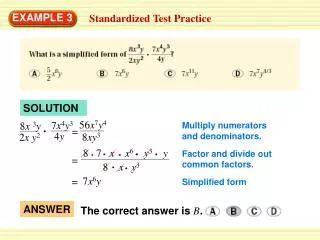
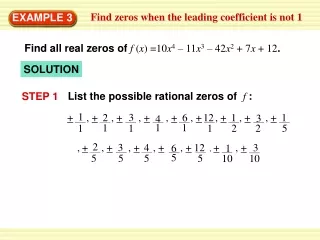
List the possible rational zeros of f : 1 3 + , + , + , + , + , + , , + 6 12 + 1 , + 1 2 3 4 1 1 1 1 2 1 1 2 5 2 3 ,+ , +, + , + , +, + , + 3 4 12 1 6 5 5 5 5 5 10 10 Find zeros when the leading coefficient is not 1 EXAMPLE 3 Find all real zeros off (x) =10x4 – 11x3 – 42x2 + 7x + 12. SOLUTION STEP 1
Choose reasonable values from the list above to check using the graph of the function. For f, the values 3 12 3 1 x = – , x = , x = , andx = 2 5 2 5 are reasonable based on the graph shown at the right. Find zeros when the leading coefficient is not 1 EXAMPLE 3 STEP 2
3 – 10 –11 –42 7 12 2 9 69 –15 39 – 4 2 21 23 10 – 26 – 3 – 4 2 –1 10 – 11 – 42 7 12 2 – 5 8 17 –12 10 – 16 – 34 24 0 ↑ 1 – is a zero. 2 Find zeros when the leading coefficient is not 1 EXAMPLE 3 STEP 3 Check the values using synthetic division until a zero is found.
1 f (x) = x + (10x3 – 16x2 – 34x + 24) 2 1 = x + (2)(5x3 – 8x2 – 17x + 12) 2 Find zeros when the leading coefficient is not 1 EXAMPLE 3 STEP 4 Factor out a binomial using the result of the synthetic division. Write as a product of factors. Factor 2 out of the second factor. = (2x +1)(5x3 – 8x2 – 17x +12) Multiply the first factor by2.
Repeat the steps above for g(x) = 5x3 – 8x2 – 17x + 12. Any zero of g will also be a zero of f. The possible rational zeros of gare: 12 1 3 4 6 2 x = + 1, + 2, + 3, + 4, + 6, + 12, + , + , + , + , + , + 5 5 5 5 5 5 3 The graph of gshows that may be a zero. Synthetic division shows that is a zero and 5 3 5 3 g (x) = x – (5x2 – 5x – 20) 5 It follows that: f (x) = (2x + 1) g (x) Find zeros when the leading coefficient is not 1 EXAMPLE 3 STEP 5 = (5x – 3)(x2 – x – 4). = (2x + 1)(5x – 3)(x2 – x – 4)
x = –(–1) +√ (–1)2 – 4(1)(–4) 2(1) x = 1 +√17 2 Find zeros when the leading coefficient is not 1 EXAMPLE 3 Find the remaining zeros of f by solving x2 – x – 4 = 0. STEP 6 Substitute 1 for a, –1for b, and –4 for cin the quadratic formula. Simplify. ANSWER 1 3 The real zeros of f are , , 1 + √17, and1 – √17. – 2 5 2 2
ANSWER 2, , 1, +2 √2 3 1 3 1 2 4 6 2 ANSWER – , , – for Example 3 GUIDED PRACTICE Find all real zeros of the function. 5. f (x) = 48x3+ 4x2 – 20x + 3 6. f (x) = 2x4 + 5x3 – 18x2 – 19x + 42