Download
1 / 1
10 likes | 128 Vues
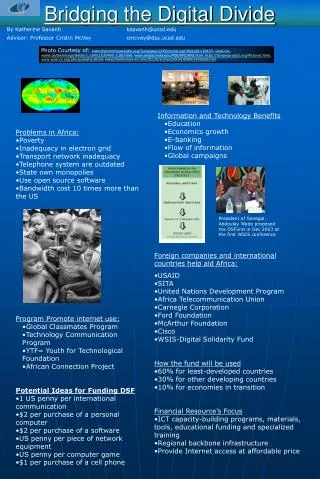
This report explores the critical challenges Africa faces in bridging the digital divide, including persistent poverty, inadequate infrastructure, and outdated telecommunications systems. It discusses the high costs associated with broadband access, significantly more than in the US. Initiatives like the Global Classmates Program and the Youth for Technological Foundation aim to enhance connectivity. Funding proposals include minimal contributions for internet communication and technology. Supported by various international organizations, the Digital Solidarity Fund emphasizes capacity-building and affordable internet access as essential for economic growth and education.

E N D
Bridging the Digital Divide By Katherine Savanh ksavanh@ucsd.edu Advisor: Professor Cristin McVey cmcvey@dss.ucsd.edu Photo Courtesy of: www.thecommonwealth.org/Templates/CYPInternal.asp?NodeID=38453, www.dw-world.de/dw/image/detail/1,1599,1535495_1,00.html, www.osdpd.noaa.gov/PSB/EPS/EPS.html, http://borgenproject.org/Pictures.html, www.wsis-cs.org/africa/whatis.shtml, www.frontlineonnet.com/fl2120/stories/20041008001405500.htm • Problems in Africa: • Poverty • Inadequacy in electron grid • Transport network inadequacy • Telephone system are outdated • State own monopolies • Use open source software • Bandwidth cost 10 times more than the US • Program Promote internet use: • Global Classmates Program • Technology Communication Program • YTF= Youth for Technological Foundation • African Connection Project • Potential Ideas for Funding DSF • 1 US penny per international communication • $2 per purchase of a personal computer • $2 per purchase of a software • US penny per piece of network equipment • US penny per computer game • $1 per purchase of a cell phone EDUCATION INTERNET CAFE • Information and Technology Benefits • Education • Economics growth • E-banking • Flow of information • Global campaigns President of Senegal, Abdoulay Wade proposed the DSFund in Dec 2003 at the first WSIS conference • Foreign companies and international countries help aid Africa: • USAID • SITA • United Nations Development Program • Africa Telecommunication Union • Carnegie Corporation • Ford Foundation • McArthur Foundation • Cisco • WSIS-Digital Solidarity Fund • How the fund will be used • 60% for least-developed countries • 30% for other developing countries • 10% for economies in transition • Financial Resource’s Focus • ICT capacity-building programs, materials, tools, educational funding and specialized training • Regional backbone infrastructure • Provide Internet access at affordable price