Download
1 / 19
190 likes | 285 Vues
Embark on a mission to reconstruct happenings from the prehistoric era by analyzing a set of fossilized tracks. Form and adjust hypotheses based on limited evidence, and explore the size, nature, and timing of organisms involved. Delve into questions about animal movement, footprint patterns, and environmental characteristics. Adapted from BSCS Lab LS Chapter 5-2 notes, this exploration of the fossil record provides insights into evolution theories and evidence, including body structures, DNA analysis, and evolutionary relationships among species.

E N D
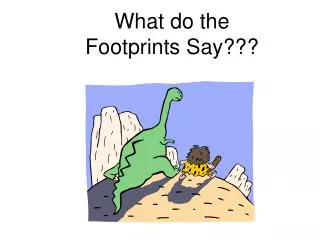
Mission • Reconstruct happenings from the geological past by analyzing a set of fossilized tracks • Form defensible explanations of past events from limited evidence. • As more evidence is available, modify or abandon your hypotheses.
Position #1 • Can you tell anything about size or nature of organisms? • Were the tracks made at the same time? • How many animals involved? • Can you reconstruct a series of events represented by this set of fossil tracks? • Suggest evidence to support your explanations!
Position #2 • With new info, revisit first explanation • MODIFY your explanation and/or add newones
Questions to Consider... • In what directions did animals move? • Did they change speed or direction? • What might have changed the footprint pattern? • Was the land level or irregular? • Was the soil moist or dry? • In what kind of rocks were the prints made? • Were sediments coarse or fine? • Characteristics of track environment?
Remember! • Any reasonable explanation must be based only on those proposed explanations that still apply when all of the puzzle is projected
For Each Explanation... • Be sure to indicate the evidence! If you could VISIT the site, what evidence would you look for to support your hypothesis? Adapted from a BSCS lab
LS Chapter 5-2 Notes The Fossil Record
What is a Fossil? • Fossil – preserved remains or traces of an organism that lived in the past. • Most fossils form when organisms that die become buried in sediments.
What Do Fossils Reveal? • Fossil record – millions of fossils that scientists have collected • Extinct – if no member of that species are still alive. • Most of what scientists know about extinct species is based on the fossil record. • Fossil record also provides clues about how and when new groups of organisms evolved.
How Fast Does Evolution Occur? Two Theories • Gradualism – tiny changes gradually add up to major changes over very long period of time • Intermediate forms appear • Punctuated Equilibria – evolution occurs during short periods of rapid change separated by long periods of little or no change. • No intermediate forms appear
Scientists compare body structures, development before birth, and DNA sequences to determine the evolutionary relationships among organisms
Similarities in Body Structure • Homologous structures – similar structures that related species have inherited from a common ancestor
Similarities in Early Development • Early embryonic stage • In early development, organism go through similar stages.
Similarities in DNA • Method: Extracting DNA to compare. • The more similar the sequences, the more closely related the species are. • Question: Which animal are closer related? • Rodent; Elephant Shrew; Elephant
Combining the Evidence • Scientists combined evidence from • Fossils • Body structures • Early development • DNA and protein sequences • In most cases, DNA and protein sequences have confirm conclusions based on earlier evidence.