Beowulf
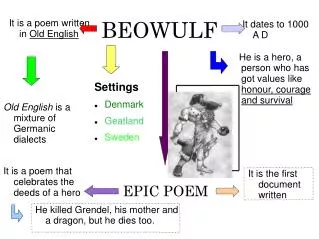
Beowulf. Introduction to Beowulf. Beowulf is one of the earliest poems written in any form of English. Actually, this writer should be called an editor because the poem had a long oral tradition and finally came to rest as what we know as Beowulf .

Beowulf
E N D
Presentation Transcript
Introduction to Beowulf • Beowulf is one of the earliest poems written in any form of English. • Actually, this writer should be called an editor because the poem had a long oral tradition and finally came to rest as what we know as Beowulf. • The original poem didn’t have a title, modern editors gave the poem its name.
More About the Editor • The “editor” was obviously well-read and conscious of his role as a poet. • This is a Christian writer balancing his faith with very Pagan themes. • We know that the editor is Christian because the only literate people of the time were those from the church.
Review of Old English History • The Celts originally inhabited Britain. • In the early 5th century, the Romans withdrew and left Britain vulnerable to Germanic invaders (Vikings).
Old English History • The Britons had become Christians in the 4th century. • The 1st attempt to Christianize the heathen Germanic tribes occurred in 597 AD when Pope Gregory sent missionaries led by Saint Augustine to Kent.
Review of Old English History • Before Christianity, there were no books. The only formally educated people were clerics in the church. • The Anglo-Saxon invaders brought a tradition of oral poetry (some of which was later written down with a religious spin after the Christian conversion.
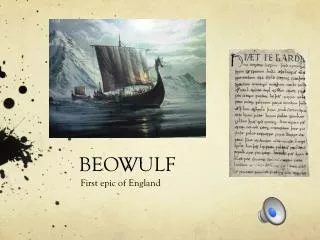
Introduction to Beowulf • There is only one survivingBeowulf manuscript and it dates from late 10th century. • This manuscript was damaged in a fire in 1731 that destroyed many other medieval manuscripts.
Original Beowulf Manuscript(Note the burn marks on the top and sides)
Introduction to Beowulf • Beowulf is recognized as a hallmark of English literature, yet its heroes and its setting are not English. • The poem is set in two places: the first half on a Danish island and the second half in Beowulf’s homeland (an island off the SE coast of Sweden).
Introduction to Beowulf • Interesting Fact: J.R.R. Tolkein (The Lord of the Rings Trilogy) was a learned Beowulf scholar. He played a huge part in getting Beowulf accepted as classic literature
Introduction to Beowulf • Beowulf is written in the epic tradition, meaning it is larger than life. • There is also liberal use of the supernatural. • The poem champions bravery, loyalty, and devotion to community.
Introduction to Beowulf • The poem portrays a strong sense of fatalism (acceptance of death) • The warriors of the era accepted their mortality in a way that seems casual to modern readers. • The concept of fate was central to the world view of Anglo-Saxons.
Beowulf The Epic An epic… • Is a long story in poem form • Has a hero • Is the story of the hero’s travels and his fights with monsters, gods, and bad guys • An epic is in 3rd person • Was originally sung • Jumps right into the plot • Contains information about the culture that created them • Offers clues as to what the author might have feared, admired, or questioned.
The Epic Warrior • Has “Larger than life” qualities, • Is a natural lead of others • Is not emotionally connected to his followers. • Is appealing to the opposite sex, but is rarely in a committed relationship • Defeats monsters and or fights for Gods
The Epic Warrior • Has “good” on his or her side • Is associated with strength and values • Often stands alone in battle • Is generally smarter than everyone else. A problem-solver • Has a fatal weakness • Is constantly on the move • Is a skilled fighter
LITERARY ELEMENT – Conflict • The central struggle between two opposing forces in a story or drama -External -Internal
External Conflict • Exists when a character struggles against some outside force -EX: fight between two people
Internal Conflict • A struggle within the mind of a character.
Recurring Themes • Christianity • Darkness and gloom • Battle and death • Revenge • Envy • Reputation
Heorot A mead hall