Understanding Population Dynamics: Age Structure, Migration Patterns, and Economic Impacts
This chapter explores the intricacies of population dynamics, focusing on age structure as an indicator of development, the relationship between demographic trends and public service demands, and the implications of migration. It discusses historical and contemporary migration patterns, including the motivations behind migration, and introduces models like the Samuelson model and the Gravity model to analyze these trends. The impact of the Baby Boom generation on social services and the effects of historical events such as 9/11 on migration policies are also examined.

Understanding Population Dynamics: Age Structure, Migration Patterns, and Economic Impacts
E N D
Presentation Transcript
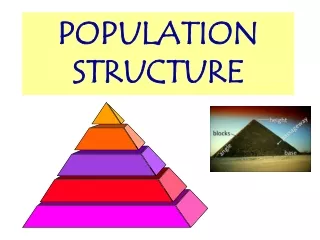
Chapter 3 continued, Population Structure • Age structure of population – an indicator of state of development • Relationship between age structure and demands for public services (education, health care…..) • Population pyramids as indicators of age and gender structure of populations – typically constructed around 5 year age cohorts
Rate of Natural Increase – any places in stage 1 demographic transition, what about stages 2 & 3, and about stage 4?
Cape Verde – high birth rates, low death rates, high natural increase
Chile – Declining Death Rate, declining rate of natural increase
Denmark – low birth and death rates, low rate of natural increase
Washington State Population Pyramids Higher % of elderly females than males Relatively even distribution up to about 50-54, typical of a developed economy
Big agriculture counties Adams, Grant, Yakima College counties – Whitman, Kittitas, Whatcom Retirement counties Jefferson, Pacific, San Juan Old wheat counties Columbia, Garfield Suburbs - Clark, Snohomish Professional – King Poor w/few 20’s-40’s: Stevens, Pend Oreille, Ferry
The Baby Boom and Its Impacts • In the U.S., this 90 million mass of people hit the labor market in the 1960’s, and will be retiring soon (like me) • The flood of workers is argued to have stimulated entrepreneurship & the demand for new products • The burden of the baby boom on social service networks is about to be felt • The baby-boom “echo” • The tempering influence of migration policy: will we return to a more liberal period post-911?
Florida argues that the • U.S. has reacted to the • 9/11 terrorist attacks • in ways that stifle the • movement of the creative • class to the U.S. • He sees this as a drag on • the U.S. ability to • to compete globally • in the development of • leading-edge industries • And U.S. educational • institutions are argued to • not be responding with • increased capacity for • U.S. citizens
Migration • A change in permanent residence • Migration motivations: push & pull factors • Migration motivations are more than economic: social and environmental • Scale of movement: from local to interregional to international – voluntary versus forced (Hurricane Katrina – is this diaspora permanent? • Historic forced migration – e.g. African slave trade; intranational movements – WW II Jewish –current civil wars in Africa
Economics of Migration: The Samuelson Model Equilibrium – when wage rate differential equals travel cost difference between regions
Migration Streams Continued • Lack of convergence in wage rates begets the Samuelson model • Cultural influences – Europe, Asia, the Americas….. Globally a Tiebout process • Impact of regulations – US post 9/11 • Historic age selectivity • Impacts of migration – social conflict; guest worker programs in Europe; welfare gains for in-migrants.
Migration Patterns to the U.S. Absolute # into U.S. rising post Vietnam War Era to levels similar to end of 19th Century Post 9-11? Remarkably different origins
Broad Global Flows of Migrants Clearly a flow from lower income to higher income locations: Is this support for the Samuelson Model?
Migration among U.S. Census Regions – Much more detail is available
The Gravity Model: “Social Physics” Iij = k * PiPj Dijb where I is interaction between place i and j, p(i) and p(j) are populations of places I and j, k is an empirically derived constant, and D(i,j) is the distance between i and j, raised to an empirically derived constant, b. Stewart, Ravenstein, Ullman
Seattle Opera Ring Cycle Doners and Distance (excluding WA) R-square .04
Seattle Opera Ring Cycle Doners and Distance (with WA) R-square .12 Weak But Highly significant Washington
Travel to the 2004 AAG Meetings in Denver Alaska & Hawaii R-square .02 Colorado
AAG Meetings in Denver, w/o CO, AK, and HI Adjusted R-square -.02
Summary • This chapter provides an overview of population trends over the long-run • The Industrial Revolution – in different places at different points in history – has had powerful impacts on population levels • Migration and natural increase vary in their regional importance over time • The Malthusian vision of population growth has been largely replaced by demographic transition models • Population movements are affected by differences in income levels, but also by environment and politics • The gravity model can be used to model some population movements, and spatial interaction for many phenomena