SOIR Instrument Calibration for Venus Express
Learn about the SOIR instrument used for solar occultation on Venus Express, including its characteristics, calibration processes, and measurement principles.

SOIR Instrument Calibration for Venus Express
E N D
Presentation Transcript
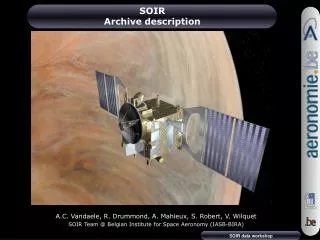
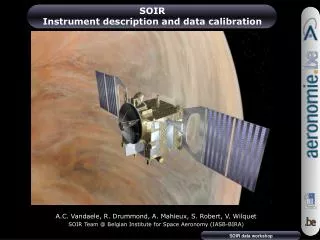
SOIRInstrument description and data calibration A.C. Vandaele, R. Drummond, A. Mahieux, S. Robert, V. Wilquet SOIR Team @ Belgian Institute for Space Aeronomy (IASB-BIRA)
Overview • Venus • Characteristics • Atmosphere • Venus Express • SOIR • Solar occultation • Instrument description • Telemetry • Calibrations • Echelle grating • AOTF • Detector • Optics • Spectrum construction • Geometry
SOIR: solar occultation – Measurement principle Orbit 232 – Order 129 Transmittance Side view To Sun VEX N View from Venus Express Venus Atmosphere
SOIR: solar occultation – Measurement principle Orbit 232 – Order 129 Transmittance Side view To Sun VEX N View from Venus Express Venus Atmosphere
HDO H2O CO2 CO SOIR: Solar occultation – Example of measured spectra • 4 different diffraction orders measured during each occultation Orbit 486 (20070820)
Overview • Venus • Characteristics • Atmosphere • Venus Express • SOIR • Solar occultation • Instrument description • Telemetry • Calibrations • Echelle grating • AOTF • Detector • Optics • Spectrum construction • Geometry
SOIR: Optical description (1) Credits: IASB/BIRA
Acousto-optic filter Echelle grating 250 µm Crystal Reflective surfaces Infrared detector Spatial direction: 256 pixels Spectral direction: 320 pixels SOIR: Optical description (2)
Overview • Venus • Characteristics • Atmosphere • Venus Express • SOIR • Solar occultation • Instrument description • Telemetry • Calibrations • Echelle grating • AOTF • Detector • Optics • Spectrum construction • Geometry
Spatial Spectral SOIR telemetry – Constraints on the combination of detector lines • Telemetry = equivalent of 8 spectra/second • If 4 orders/second 2 spectra/order = 2 ‘bins’ Detector: 320 x 256 pixels 32 illuminated rows
Slit position during an occultation Spatial Spectral Bin 1 Bin 2 60 km 60 Venus
Overview • Venus • Characteristics • Atmosphere • Venus Express • SOIR • Solar occultation • Instrument description • Telemetry • Calibrations • Echelle grating • AOTF • Detector • Optics • Spectrum construction • Geometry
Diffraction order Echelle grating: Blaze function • The efficiency of the grating in terms of refracted angle • Is maximum when the refracted angle = incident angle Mahieux, A. et al, 2008. In-flight performance and calibration of SPICAV/SOIR on-board Venus Express. Applied Optics, 47(13), 2252–65.
Acousto Optical Tunable Filter: Characteristics • Calibrations: • 1. AOTF bandpass function • TAOTF = f(l, l0, DlFWHM) • 2. Tuning function • l0 = f(RF) • 3. Bandwidth • DlFWHM = f(l) Mahieux, A. et al, 2008. In-flight performance and calibration of SPICAV/SOIR on-board Venus Express. Applied Optics, 47(13), 2252–65.
Acousto Optical Tunable Filter: Characteristics –Bandpass function Mahieux, A. et al. 2009. A New Method for Determining the transfer function of an Acousto Optical Tunable Filter. Optics Express, 17, 2005–2014.
Acousto Optical Tunable Filter: Characteristics –Tuning function • Tuning function: • Relation between the radiofrequency applied to the crystal and the central wavenumber of the filtered spectral interval • By-product of the previous analysis • Different for the different bins • Different parts of the crystal Mahieux, A. et al, 2008. In-flight performance and calibration of SPICAV/SOIR on-board Venus Express. Applied Optics, 47(13), 2252–65.
Acousto Optical Tunable Filter: Characteristics – Order width vs. AOTF FWHM
Instrumental Wavenumber calibration • Use of Solar lines in a lot of distinct orders • Correction for Doppler satellite (rec) – Sun (em) • Pixel – wavenumber – order relation • Wavenumber to pixel relation: Should be considered with care!
Instrumental Spectral Sensitivity • Spectral dependence of the whole instrument as a function of the incoming light wavelength • Obtained from direct Sun measurements, fullscan observations
Overview • Venus • Characteristics • Atmosphere • Venus Express • SOIR • Solar occultation • Instrument description • Telemetry • Calibrations • Echelle grating • AOTF • Detector • Optics • Spectrum construction • Geometry
Measured spectrum SPICAV/SOIR instrument description:Measurement principles – diffraction order addition (1) • AOTF transfer function: sinc² like • AOTF transfer function shape determination is critical • 7 diffraction orders have to be taken into account to correctly reconstruct measurement spectra AOTF transfer function Central order Mahieux, A. et al, 2008. In-flight performance and calibration of SPICAV/SOIR on-board Venus Express. Applied Optics, 47(13), 2252–65.
SPICAV/SOIR instrument description:Measurement principles – diffraction order addition (2) Mahieux, A. et al, 2008. In-flight performance and calibration of SPICAV/SOIR on-board Venus Express. Applied Optics, 47(13), 2252–65.
Overview • Venus • Characteristics • Atmosphere • Venus Express • SOIR • Solar occultation • Instrument description • Telemetry • Calibrations • Echelle grating • AOTF • Detector • Optics • Spectrum construction • Geometry
Geometry – Tangent altitude calculation (1) • The instrument points to the Sun • Pointing direction displaced of 10’ above the centre of the Sun • Account for diffraction
Geometry – Tangent altitude calculation (2) • Size of the slit is 30’ x 2’ (spectral x spatial) • VEX is inertial pointing rotation of the slit
Geometry – Tangent altitude calculation (3) • Use of SPICE to calculate the tangent altitude • From reconstructed kernels delivered by ESOC • Pointing angle for one bin of the slit: • Tangent altitude: