
Effects of High Soil Nitrogen on Cover Crop Stand Dominance
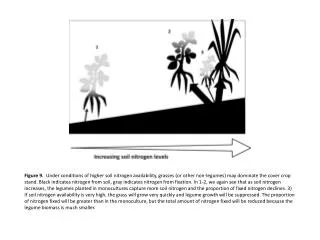
Under conditions of higher soil nitrogen availability, grasses may dominate the cover crop stand. Graphs show how legumes capture more soil nitrogen in monocultures, leading to decreased fixed nitrogen proportion. Excessive soil nitrogen favors grass growth, suppressing legumes. Despite higher nitrogen fixation proportion in this scenario, total fixed nitrogen is reduced due to smaller legume biomass.

Effects of High Soil Nitrogen on Cover Crop Stand Dominance
E N D
Presentation Transcript
Figure 9. Under conditions of higher soil nitrogen availability, grasses (or other non-legumes) may dominate the cover crop stand. Black indicates nitrogen from soil, gray indicates nitrogen from fixation. In 1-2, we again see that as soil nitrogen increases, the legumes planted in monocultures capture more soil nitrogen and the proportion of fixed nitrogen declines. 3) If soil nitrogen availability is very high, the grass will grow very quickly and legume growth will be suppressed. The proportion of nitrogen fixed will be greater than in the monoculture, but the total amount of nitrogen fixed will be reduced because the legume biomass is much smaller.
